
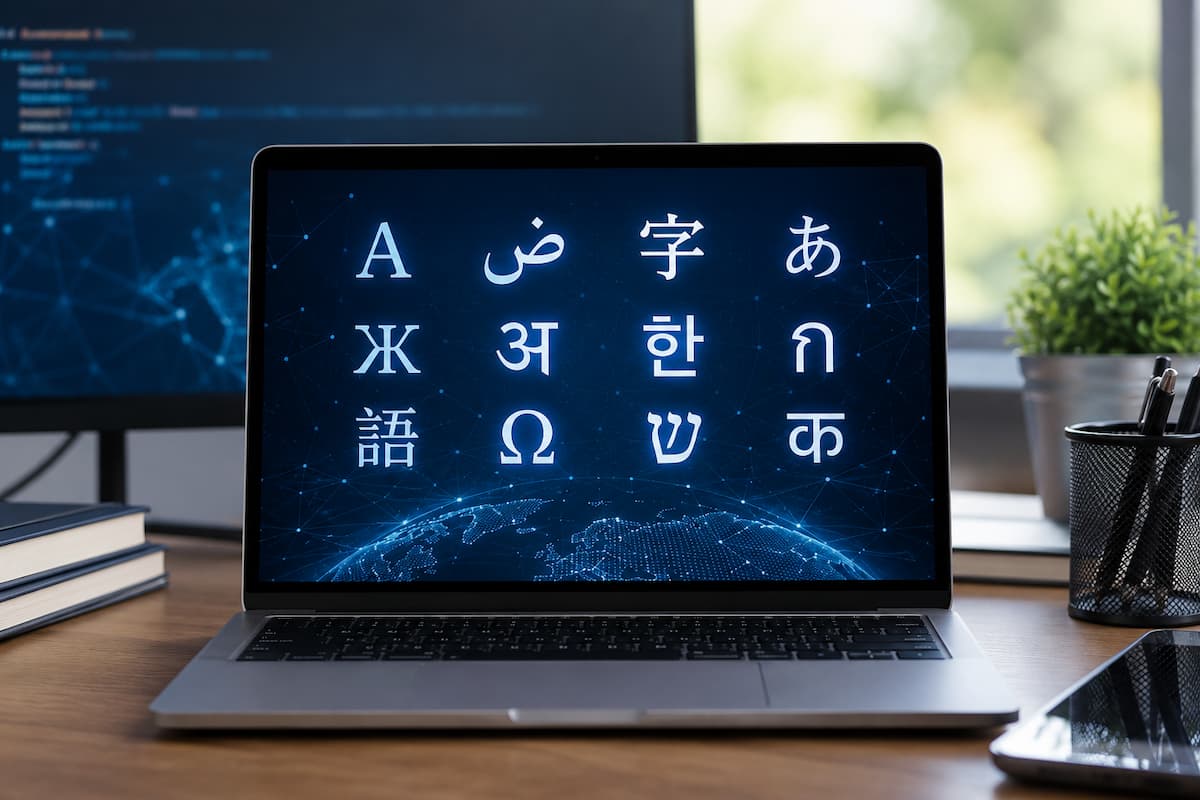
Unicode solved this age-old problem by providing a globally universal text representation system. Unicode offers a standard basis for computers to recognize and process a wide range of text characters. Unicode forms the basis of websites, instant messaging applications, operating systems, databases, documents, and other digital services. Its operation explains why you can type in multiple languages, use accented letters, and use emojis on modern smartphones.
What Happened Before Unicode?
Computers do not understand written language the way humans do. Basic number systems use numbers. Computers must associate numerical values with letters, numbers, punctuation marks, and symbols to display text. ASCII, an early and widely used system, represented only a limited set of American English characters. ASCII could represent simple English text, but not all writing systems in the world.
With the globalization of computer technology, different character encoding schemes supported diverse languages. A system could assign numerical values to different characters for a specific language. This led to problems with text compatibility between systems. Imagine writing a document with special characters on one computer and then opening it on another computer with a different encoding. You might see strange symbols or empty boxes instead of text. The data is stored, but the receiving system misinterprets it.
The Importance of Character Encoding
Text is encoded into numerical data through character encoding. Without a uniform encoding method, computers struggle to share written information. This has become particularly important with the development of the Internet. Global networks must be able to process multilingual identities, websites, emails, databases, and documents. A system that only supports English cannot support global communication.
| Challenge | Problem Without Broad Character Support | Benefit of Unicode |
|---|---|---|
| Multiple languages | Different systems could interpret characters differently | A shared standard for representing characters |
| Data exchange | Text could become corrupted between systems | More consistent text interoperability |
| Web content | International characters could display incorrectly | Broad support for global digital content |
| Software development | Developers had to manage multiple encoding systems | A common framework for handling text |
What Unicode Actually Does
Unicode offers a universal system for identifying characters used in written communication and other text-based symbols. It assigns unique code points to characters, enabling software to differentiate between them in a standardized manner. This does not imply that Unicode itself regulates the appearance of each character. Fonts and rendering software significantly influence the appearance of a character. Fonts determine how a character is visually represented, while Unicode provides the fundamental identity.
This distinction is crucial. If a device recognizes a Unicode character but lacks an appropriate font, it may display a box or another replacement symbol. Even if the visual presentation is insufficient, the Unicode data itself may remain accurate. Consider Unicode as a digital text identification system that is universally recognized. It facilitates the consensus among computers regarding the identity of a character, while fonts and rendering systems determine the character’s appearance on the screen.
Comprehending Unicode Code Points
A code point is assigned to each Unicode character. A code point is a numerical value that is assigned to a character in the Unicode standard. For instance, the Unicode code point U+0041 is assigned to the Latin capital letter A. The notation commences with the character “U+” and is followed by a hexadecimal number. Other characters, such as those from non-Latin writing systems, possess their code points.
This method provides software with a consistent means of character identification. Nevertheless, the number of bytes utilized to store a character is not the same as a code point. This is the point at which encoding formats like UTF-8 and UTF-16 become crucial.
Why UTF-8 Became So Significant
UTF-8 is one of the most frequently employed Unicode encoding formats. It offers a method for storing Unicode characters as sequences of bytes while ensuring compatibility with standard ASCII for fundamental English characters. This rendered UTF-8 particularly advantageous for the internet. While gaining access to a much broader range of characters, existing systems that already handle ASCII could be configured to operate with UTF-8.
The number of bytes utilized by UTF-8 is contingent upon the character. Common ASCII characters necessitate fewer bytes, whereas other Unicode characters may necessitate more. This design ensures that UTF-8 remains efficient for text that extensively employs basic Latin characters while still supporting global writing systems.
UTF-8, UTF-16, and UTF-32:
UTF-8 is not the sole Unicode encoding. In specific software environments, UTF-16 and UTF-32 are also implemented. They differ in the manner in which Unicode code points are represented and stored. Unicode is the character standard that is most significant to everyday web users. UTF-8, UTF-16, and UTF-32 are distinct methods of encoding Unicode text for digital storage and processing.
Unicode’s Contribution to the Support of Global Languages
Unicode’s most significant contribution to global computing is its capacity to accommodate a diverse array of writing systems. Latin-based alphabets, as well as scripts such as Arabic, Chinese, Cyrillic, Devanagari, Greek, Hebrew, Japanese, Korean, and many others, are included in this standard.
This support enables users to generate and distribute digital content without the need for distinct character systems for each language. A database can store information from users around the world using a common encoding framework, and a website can contain multiple writing systems. Unicode also facilitates the integration of marks and other features that are necessary to represent intricate written text. Nevertheless, the accurate representation of certain writing systems necessitates more than the mere storage of Unicode characters. Software must also comprehend the regulations regarding direction, shaping, and layout.
Unicode and Emoji
The use of emojis further illustrates Unicode’s influence on contemporary communication. Unicode assigns standardized code points to numerous emoji characters, enabling systems to exchange them as digital text. The visual aspect of an emoji can differ across different platforms. The same emoji may appear slightly different on a phone, computer, or messaging service due to the fact that each platform may employ its own design.
This distinction is analogous to the distinction between a character’s identity and its visual appearance. The platform determines the method of displaying the standardized character information, while Unicode provides it. Sequences or variations can also be generated by combining certain emojis. This implies that what appears to be a single visual symbol may actually be the result of the collaboration of multiple Unicode characters.
The Impact of Unicode on the Web
Reliable text encoding is a critical component of the contemporary web. Websites must ensure that they display their content effectively on a variety of devices, operating systems, languages, and browsers. Browsers can accurately interpret the text of a website when it declares and employs the appropriate character encoding. UTF-8 is a popular choice for web pages due to its compatibility with existing web technologies and its ability to accommodate a wide variety of characters.
When a website stores text using one encoding, but another system interprets it as something else, issues may still arise. This can result in garbled characters, often called “mojibake.” You can mitigate these issues by employing consistent data management and accurate encoding declarations.
Common Unicode Issues
Unicode resolved numerous compatibility concerns; however, it failed to resolve each text-related issue. Encoding errors may still be encountered by developers when systems employ inconsistent settings or inaccurately convert data. Visually similar characters are another prevalent issue. While possessing distinct Unicode identities, two characters may appear nearly identical. This can be a significant factor in security-sensitive applications, domain names, and identities.
Text processing can also be complex due to the fact that what users perceive as a single visible character may actually be composed of multiple code points. Therefore, developers who work with text should refrain from presuming that a single character equals a single byte or even a single Unicode code point. Do not assume that the number of bytes equals the number of visible characters. Unicode text has the potential to combine multiple code points into a single displayed character and can utilize varying quantities of bytes.
The Persistence of Unicode’s Significance
Unicode has now become deeply ingrained in modern computing. It facilitates the use of international websites, messaging platforms, operating systems, databases, programming environments, and digital documents. Most users never have to consider character encoding, which is why its significance is simple to overlook. The text typically appears correctly when you type a name in your native language, send a message, or visit a website.
This convenience is contingent upon the consensus of numerous systems regarding the appropriate representation of digital text. Unicode established the shared foundation that made this degree of international compatibility possible. Unicode comprehension is also advantageous for technology professionals and developers. The proper handling of text impacts data storage, search, databases, web development, software localization, and security. Unicode elucidates the ability of contemporary devices to communicate across languages without necessitating a distinct digital system for each alphabet or writing system for ordinary users.
Conclusion
Unicode created a universal language for global computer systems by providing a common way to recognize and process written characters for digital systems. Before its widespread adoption, incompatible character encoding systems made international text exchange extremely difficult. Unicode offers a more consistent basis for websites, software, databases, documents, and digital communication.
The impact of Unicode is noticeable when someone writes in another language, uses accented characters, searches for international content, or sends emojis around the world. This technology may work silently in the background, but its impact is enormous. Unicode makes computer use truly accessible to users worldwide by creating a universal framework for digital text.
FAQs
1. Are Unicode and UTF-8 the same?
No. Unicode is a broader standard for recognizing and displaying characters, whereas UTF-8 is an encoding format for storing and transmitting Unicode text. UTF-16 and UTF-32 are other Unicode encoding formats. In short, Unicode provides a character framework, while UTF-8 describes a method for encoding those characters as digital data.
2. Why is Unicode needed if ASCII already exists?
While ASCII is useful, it has limitations. The design, based on a relatively small character set, cannot adequately represent the countless writing systems used worldwide. Now that computers have become global communication tools, a broader standard is needed. Unicode expands character support, allowing digital systems to process text from multiple languages using a common framework.
3. Why do I sometimes see boxes instead of characters?
Boxes or substitute symbols may appear when software or devices do not display a character correctly. The problem may be due to a missing font, incomplete display support, or other compatibility issues. Unicode may recognize the character correctly, but the system still requires the right software and fonts to display it properly.
4. Can Unicode display all languages?
Unicode is designed to support an expansive range of writing systems and is still under development. However, digitally representing a language involves more than just assigning characters. Some languages require specific shapes, layouts, or display rules. Unicode provides an important foundation, but full language support also depends on software, fonts, and operating systems.
5. Why does the same emoji look different on different devices?
Unicode standardizes the underlying characters of emojis, not one mandatory visual design. Each operating system or platform can use its own graphic representation to display the character. Therefore, emojis sent between different devices may look slightly different, even if they represent the same Unicode character or sequence.