
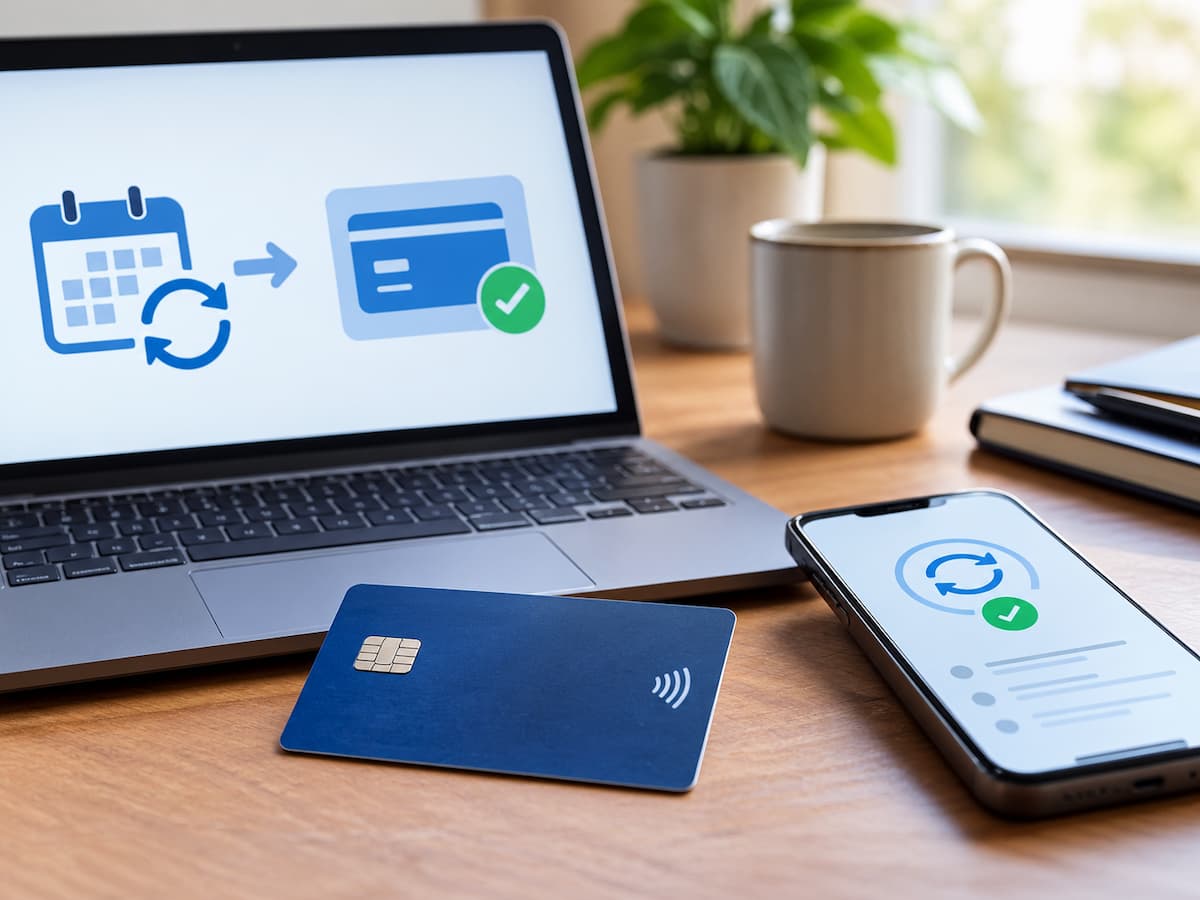
Imagine a customer subscribes to an online learning platform and pays monthly with a debit card. For several months, every renewal succeeds automatically. Then the card reaches its expiration date. The customer receives a replacement card from the bank but does not visit the subscription website to update the payment details. When the next renewal arrives, the merchant faces a practical question: should the system attempt the saved card, look for updated credentials, ask the customer to provide another payment method, or temporarily pause the subscription?
The answer depends on how the merchant’s recurring-billing system manages stored payment credentials, interprets the payment response, and handles failed renewals. Some card updates can happen automatically through supported services, while others require action from the customer. Understanding this process helps subscription businesses reduce avoidable interruptions without repeatedly submitting unsuccessful charges or compromising customer trust.
1. How Recurring Card Payments Work Differently
In a one-time online purchase, the customer generally enters payment details, confirms the purchase, and authorises the transaction through the merchant’s checkout process. The merchant processes that payment for the immediate order. Recurring billing follows a different operational pattern. During the initial purchase, the customer agrees to a subscription and provides a payment method for future charges under the applicable terms. The merchant or its payment provider retains a reference to that payment method and associates it with the customer’s subscription.
When the next billing date arrives, the billing system identifies the subscription, calculates the amount due, and requests a payment using the saved credential. The customer does not normally need to re-enter card details for every renewal. This convenience introduces an ongoing responsibility: the saved payment method must remain usable, and the merchant must respond appropriately when it changes or stops working.
A recurring payment can fail even when the subscription was previously paid successfully. The card might have expired, the issuing bank might have replaced the account, the available balance might be insufficient, or the issuer might decline the transaction for another reason. The billing system therefore needs more than a scheduled charge. It needs a process for interpreting results, managing updated credentials, communicating with customers, and determining whether a subscription should continue.
2. Understanding the Different Types of Card Problems
Not every failed renewal means that the customer’s card has expired. Merchants should distinguish between the underlying credential problem and the result of a particular payment attempt.
An Expired Physical Card
A card’s printed expiration date has passed. The issuing bank might already have provided a replacement, but the merchant’s saved information may still contain the previous expiration date. An expired card does not necessarily mean that the underlying account has closed. Updated credentials might be available through an eligible account updater service, or the customer might need to enter the replacement card manually.
A Replaced Card
Banks may issue replacement cards when an existing card expires, is damaged, is lost, or is reported stolen. Depending on the situation, the replacement may retain the same account number or use a different one. The merchant cannot safely assume that every replacement will preserve all previously stored details. It must rely on supported update mechanisms or request new information from the customer.
A Changed Card Number
A card replacement may involve a new primary account number, commonly called a PAN. Updating only the expiration date will not solve a problem when the stored number itself has changed. A supported account updater may supply the replacement account information. If no update is available, the customer may need to add the new card through the merchant’s secure payment form.
An Invalid Stored Credential
A stored credential can become unusable for reasons beyond expiration. It might have been deleted, disabled, incorrectly associated with a customer, or invalidated following an account closure or other change. In this situation, simply changing the expiration date or retrying the existing reference may not help. The merchant needs to determine whether the payment provider can repair or refresh the credential or whether a replacement payment method is necessary.
A Declined Recurring Charge
A decline is the outcome of a payment attempt, not a complete diagnosis of the underlying problem. An issuer might decline a renewal because of insufficient funds, a restriction on the account, suspected unauthorised activity, or another reason. Some failures are temporary; others require the customer to contact the issuer or provide a different payment method. Merchants should use the response information supplied by their payment provider rather than treating every decline as an expired-card problem.
3. How Card Account Updater Services Help
Card networks offer account updater services that can help participating merchants obtain updated credentials when a customer’s payment account changes. Examples include the Visa Account Updater and the Mastercard Automatic Billing Updater. These services allow eligible participants to exchange updated account information for supported stored-credential and recurring-payment use cases.
The basic process is straightforward:
- A merchant has a saved card credential associated with a customer.
- The card issuer records a change, such as a replacement card or a new expiration date.
- Through an eligible payment provider or acquiring arrangement, the merchant can request available updated information or receive it through a supported update process.
- The payment system updates the relevant stored credential when appropriate.
- A later renewal can use the updated information, subject to normal authorisation requirements.
Account updater services do not guarantee that every card will be updated. Availability depends on factors such as card-network coverage, issuer participation, merchant eligibility, geographic support, and the payment provider’s integration. An updater might return new information, indicate that nothing has changed, or report that the account has been closed. In some cases, the customer must provide new details.
Merchants should also check whether their provider supports updates before a renewal, after a decline, or through periodic batch processing. These approaches have different operational implications. For example, Adyen documents a real-time process that checks for available account updates after certain refused payments and can retry with updated details during the same processing flow. Its documentation also identifies eligibility requirements and outcomes that require the shopper to supply new details. These are provider-specific capabilities, not universal features of every payment integration.
4. The Role of Payment Tokens and Stored Credentials
Many recurring-payment systems avoid repeatedly handling raw card numbers by using a payment token or a provider-managed reference to stored payment details. A token acts as a reference that enables an authorised payment system to use a saved payment method without requiring the merchant’s ordinary application to store the full card number. The exact arrangement depends on the provider and integration. Tokens can make recurring billing easier to manage, but they should not be treated as permanent guarantees that a card will always work.
Some providers can update their stored card records automatically when account updater services return new information. Others require the merchant to process an update or maintain additional information in its own systems. Certain tokens may become invalid or unusable after a card or account change.
The important distinction is between the identity of the stored payment reference and the validity of the underlying payment account. A token may remain unchanged while its associated card details are refreshed. In another situation, the saved credential may need to be disabled and replaced. Merchants should follow their provider’s documented procedures rather than assuming that every token automatically adapts to every card change. They should also keep subscription records, customer records, and payment-method references correctly associated. Otherwise, an update might be applied to the wrong record or a renewal might continue using an outdated reference.
5. Hypothetical Subscription Timeline: An Expired Card
Consider a subscription to a business software service that renews monthly for a fixed amount. The customer originally saved a debit card and agreed to recurring billing. The following timeline illustrates one possible workflow. It is hypothetical; actual outcomes and timing depend on the provider, issuer, subscription terms, and applicable requirements.
| Stage | What Happens | Appropriate Response |
|---|---|---|
| Before renewal | The saved card approaches its expiration date. | Send a reminder when appropriate and check whether an eligible updater service is available. |
| Renewal day | The billing system submits the scheduled payment. | Use the supported stored credential and record the result. |
| Initial failure | The provider reports a decline associated with outdated card information. | Check for an available account update if the integration supports it. |
| Credential update | The updater returns a new expiration date or replacement account number. | Refresh the relevant stored credential according to provider instructions. |
| Further authorisation | The system attempts payment using the updated credential when supported and appropriate. | Record the final outcome; an updated card can still be declined. |
| Unresolved failure | No usable update is available, or the account is closed. | Notify the customer and request a valid payment method or issuer assistance. |
| Subscription review | Payment remains outstanding beyond the configured grace period, if one applies. | Follow the disclosed subscription policy for continued access, suspension, or cancellation. |
The central lesson is that updating credentials and collecting payment are separate events. A card updater can supply more current information, but it does not guarantee authorization. Likewise, a successful authorization does not by itself determine how the merchant should manage the subscription record or communicate the renewal outcome.
6. Designing Sensible Retry Logic
When a recurring payment fails, the billing system must decide whether another attempt is appropriate and, if so, when to make it. A retry is most useful when the failure may be temporary or when a meaningful change has occurred. Repeatedly submitting an identical transaction with the same unusable credential is unlikely to solve an expired-card problem. It can also create unnecessary processing activity and frustrate customers.
Merchants should classify payment responses using the provider’s documented decline categories and recommendations.
Temporary Failures
Some failures may be temporary, such as insufficient available funds or a short-lived issuer or processing problem. Depending on the response and provider guidance, a later attempt may succeed. The retry schedule should consider the reason for failure, the subscription’s billing terms, the customer’s experience, and the provider’s supported retry rules. There is no single retry interval that is appropriate for every payment failure.
Failures That Need Customer Action
Other responses indicate that automated retries are unlikely to help. A closed account, an invalid credential, or a requirement for the cardholder to contact the issuer may require direct intervention. In these cases, the system should stop unproductive retries and explain what the customer needs to do. The next step might be entering a replacement card, contacting the bank, or selecting another supported payment method.
Preventing Duplicate Charges
A well-designed retry process also checks the status of earlier attempts before creating another payment request. Network delays, timeouts, or delayed status updates can leave the billing system uncertain about whether an attempt succeeded.
Where supported, merchants should use the provider’s documented idempotency and payment-status mechanisms to avoid accidentally creating duplicate charges. They should not interpret a missing immediate response as proof that the payment failed. Retry policies must also respect payment-provider instructions, card-network requirements, customer authorization, and applicable jurisdictional rules. A technically possible retry is not automatically an appropriate one.
7. Communicating With Customers Before and After Failure
Clear communication can prevent a routine credential update from becoming a subscription interruption.
Make Payment-Method Updates Easy
Provide a recognizable account section where customers can review their saved payment method and replace it when necessary. Display only the information needed to identify the card, such as its brand and last four digits, along with an expiration date when appropriate.
The update process should work on mobile devices, explain which fields need attention, and provide a clear confirmation when the new method has been saved. Avoid asking customers to email card numbers or send sensitive payment information through ordinary support messages.
Send Useful Billing Reminders
Where appropriate, send reminders before a card expires or a renewal is due. A reminder should explain what the customer needs to do, when the next renewal is expected, and where to update the payment method.
An expiration reminder should not imply that payment will certainly fail. An account updater might refresh the credentials automatically, and expiration alone does not establish that the underlying account is unusable. After a failed renewal, the message should describe the problem accurately without exposing unnecessary payment details. It should provide a secure update link or explain when contacting the card issuer is necessary.
Explain Subscription Status Clearly
Customers should be able to distinguish among a scheduled renewal, a payment awaiting another attempt, a failed renewal requiring action, a subscription temporarily restricted under its terms, and a cancelled subscription.
The account page and notification messages should agree about the current state. If a customer updates a card successfully, the system should explain whether the outstanding renewal will be attempted again automatically or whether another action is required. This clarity reduces avoidable support requests and helps customers understand whether access will continue.
8. Consent, Security, and Responsible Credential Handling
Recurring payments should follow the customer’s agreement and the merchant’s disclosed subscription terms. The payment method should be used only for authorized purposes, and any material changes to billing arrangements should be handled according to applicable requirements. Merchants should use a payment provider with appropriate security controls and documented support for stored credentials. Avoid storing full card numbers in ordinary application databases when a provider-managed storage and tokenization arrangement can meet the business need.
Access to payment-management functions should be restricted to authorized staff and systems. Administrative accounts should use appropriate authentication, and access to payment records should be limited to people who need it for their work. Logs should contain enough information to investigate failures without unnecessarily recording sensitive card details. Passwords, authentication secrets, and payment credentials should never be exposed in support tickets, analytics tools, or general application logs.
Payment providers can reduce the merchant’s exposure to sensitive card data, but they do not remove every security responsibility. Merchants should confirm which systems receive card information, how saved credentials are managed, and which compliance obligations apply to their particular setup. Finally, credential updates should not override a customer’s decision to stop authorizing recurring payments. An updated card is not permission to continue charging when the required authorization has been withdrawn.
9. Troubleshooting Common Recurring-Payment Failures
The following table provides a practical starting point. The exact meaning of a response should always be confirmed against the payment provider’s documentation.
| Problem | Possible Explanation | Appropriate Next Step |
|---|---|---|
| Renewal fails with an expired-card response | The stored expiration date is outdated. | Check for an eligible account update or ask the customer to update the card. |
| Renewal fails after a replacement card arrives | The card number or other account information changed. | Check supported updater results; request a replacement method if no usable update is available. |
| Card updater reports no change | No update was returned, or the saved information remains unchanged. | Review the result and determine whether customer action is required. |
| Issuer reports that the account is closed | The existing account is no longer usable. | Disable the unusable credential as required and ask the customer to provide another method. |
| Payment fails because funds are insufficient | The account may not have enough available funds. | Follow provider guidance for any permitted retry and explain the outstanding payment to the customer. |
| Issuer declines the transaction for another reason | An account restriction or issuer decision may be involved. | Review the response category and direct the customer to the issuer when appropriate. |
| Stored payment reference is invalid | The saved credential may have been removed, disabled, or incorrectly linked. | Verify the customer and subscription association, then follow the provider’s credential-replacement process. |
| Payment status is unclear after a timeout | The original attempt may still be processing or its result may not have reached the merchant. | Retrieve the payment status before initiating another charge. |
| Customer updates the card but renewal still fails | The new credential may not have been applied correctly, or the issuer may still decline the payment. | Verify the saved method and latest payment result before deciding on another attempt. |
| Payment succeeds but access remains suspended | The subscription system may not have processed the successful payment event. | Check the payment-to-subscription update process and correct the subscription status. |
Troubleshooting should focus on the underlying reason rather than the visible symptom alone. An expired-card message calls for a different response from an insufficient-funds decline, and an invalid token requires a different investigation from a delayed payment response.
10. How Failed Renewals Affect Service and Records
An unsuccessful recurring charge can interrupt a customer’s access to software, online learning, memberships, or other subscription services. If the merchant suspends access immediately, a temporary payment problem may become a poor customer experience. If access continues indefinitely without a clear policy, the business may accumulate unpaid subscription periods. Merchants should define how billing failures affect service continuity, including any grace period, reminder sequence, and suspension or cancellation conditions. These rules should be consistent with the subscription agreement and applicable requirements.
The billing system should also maintain a clear history of renewal attempts, credential updates, payment outcomes, customer notifications, and subscription-status changes. This record helps staff understand why access was interrupted and whether a successful payment has been reflected in the customer’s account.
Accounting records should distinguish between a scheduled amount due, an unsuccessful payment attempt, and a confirmed successful payment. A retry should not be treated as a new subscription purchase merely because it is a separate technical attempt. Consistent records help prevent duplicate billing entries and confusion about outstanding amounts. The goal is to keep the subscription, payment status, customer communication, and internal records aligned throughout the renewal lifecycle.