
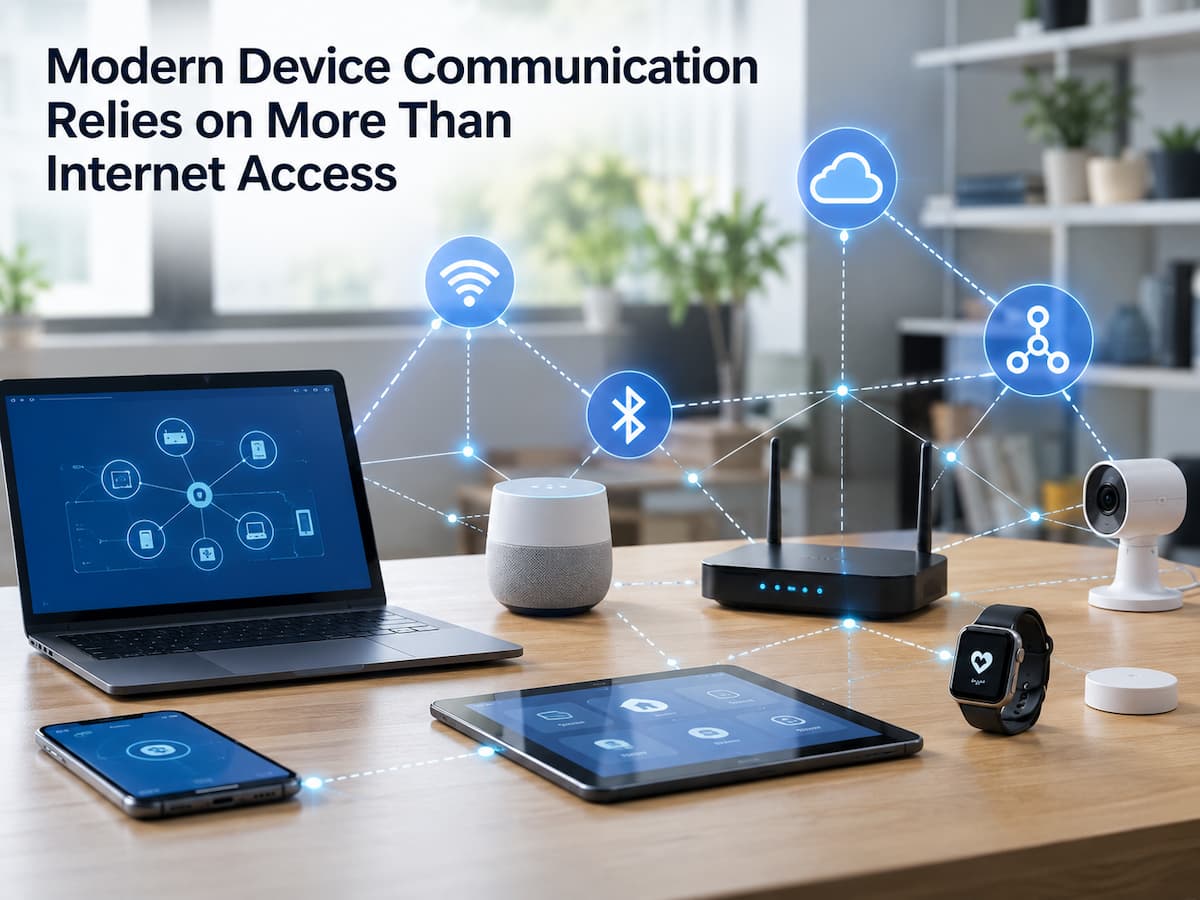
Connecting a device to the internet is often the last step in making it fully functioning. A laptop joins a Wi-Fi network, a smart TV has an online status light, or an industrial sensor reports that it’s on the network. Then it’s easy to believe that the device can communicate with anything it needs. In fact, access to the Internet is merely one layer of a much larger communication framework. Before devices can share useful information, they need to recognize each other, decide on the right ways to communicate, create trusted connections, and frequently work together via extra infrastructure located outside the local network.
This distinction is becoming more important as modern environments are made up of much more than traditional computers. Smartphones communicate with wearables; home automation systems make commands with cloud platforms; cars talk to remote services; manufacturing equipment reports operational data to centralized monitoring systems; and medical devices synchronize data with healthcare applications. All these instances may require Internet connectivity, but the communication architecture that makes them possible is much more than the capacity to send and receive data over a network.
Devices Need a Common Language to Communicate
Just because two devices are on the same network doesn’t mean they can communicate with each other well. First, they have to agree on how information should be packaged, conveyed, and interpreted. Communication protocols provide the norms for every step of a contact and communicate the common understanding.
To understand this we can look at devices from different manufacturers. A wireless security camera, a smart speaker, and a network printer could all be on the same Wi-Fi connection, but they all have a completely different purpose. Without a standard way to communicate, every manufacturer would have to write proprietary software that could understand every other product on the market. Instead, devices adhere to widely accepted protocols that allow separately built systems to communicate data in a predictable manner while preserving their specific functions.
Even if two devices do similar jobs eventually, they can still use different protocols depending on the environment they are operating in. Industrial automation, consumer electronics, cloud platforms, and enterprise systems all tend to use communications that match their own performance, reliability, and security requirements.
Communication Passes Through Several Intermediaries
Most people consider device communication to be a direct dialog between two connected systems. Of course there are direct connections. But in many modern digital environments there are often other things that route, translate, secure, or coordinate information before it gets to its final destination.
Imagine a fitness tracker syncing activity data with a mobile app. The tracker may first communicate with the smartphone via a short-range wireless technology (e.g., Bluetooth). The smartphone then sends the information over an encrypted internet connection to a cloud service, where the data is processed, saved, and matched to the relevant user’s account. At a later time, another device, say a tablet or web browser, receives that same information from the cloud platform, rather than speaking directly with the tracker.
A number of independent systems make this interaction possible, and the user experiences it as a single coherent synchronized environment. They serve a specific function so that the total communication process can be scalable and efficient, without every device having to maintain relationships with all the other devices.
Shared Infrastructure for Device Communication
Supporting infrastructure for many modern linked devices includes the following:
- Local network hardware to provide connectivity.
- Protocols that define how information is transferred.
- Authentication services that validate trusted devices.
- Synchronization coordination in cloud platforms.
- Messaging services for command and notification
- Software integration application programming interfaces (APIs).
- Monitoring systems are used for communication events.
Not all of these components will be involved in every encounter, but combined they do demonstrate how device communication extends much beyond simple internet connectivity.
Security Starts Before Information is Transmitted
Just because a network connection is made doesn’t mean that devices trust each other. Most systems authenticate that they are talking to an authorized device and not some random or malicious participant before passing meaningful data.
This verification may consist of multiple independent methods. Before standard communication, devices may show digital certificates, exchange encrypted keys, authenticate identities through authentication services, or ensure software versions meet security requirements. These checks often take place in seconds but have great importance for the total security of connected environments.
This bedrock of trust is crucial; without it, devices would have difficulty distinguishing between legitimate communication and unauthorized requests. With the proliferation of connected systems, validating identification is as critical as establishing network connectivity itself.
Type of Device Changes Communication Requirements
Not all connected devices care about the same characteristics. Video conferencing systems give priority to low latency since any visible delay disrupts the interaction. The environmental sensors that monitor agricultural conditions can afford some delay in transmission as long as the measurements are reliable. Industrial control systems need consistent communication with little disruption, and software updates prioritize reliable delivery over speed.
These differences are recognized, and the communication architectures are designed to meet the needs of the devices they support, rather than assuming that one approach is equally effective for all situations. Some systems are constantly transmitting massive amounts of data, while others are dormant for hours at a time and then transmit a short status report. Some need responses within milliseconds, while others want reliability over the long term rather than quick contact.
This variety of objectives helps us understand why the communication of current devices depends on a variety of technologies and supporting services, rather than just an internet connection.
Communication Does Not Need Devices to Be Active Simultaneously
One hallmark of current connected systems is that not all participating devices need to be online at the same time. A smartphone may be shut off for hours. A laptop may be unplugged on a trip. A smart appliance may lose its internet connection for a moment due to maintenance or a network outage. But when connectivity is restored, communication is generally re-established with little or no user intervention.
This is enabled by the fact that many communication platforms are designed to be resilient in the face of temporary outages, not to expect that each connection will be available forever. Often messages, status updates, configuration changes, and synchronization requests can be queued up until the receiving device is up again. Instead of considering each interruption as a break in communication, the infrastructure aims to maintain continuity whenever possible.
This ability has become more and more important as connected devices explode beyond traditional computers. Mobile devices often switch between different networks. Sensors with batteries save energy by connecting only at certain times. Remote equipment may be located where network availability fluctuates throughout the day. Thus, communication systems are concerned not only with delivering information but also with controlling the timing of that information.
Device Discovery Is a Communication Process in Its Own Right
Often before two systems can share relevant information, they need to learn that the other device is there and how to initiate conversation. This stage gets much less attention than the transmission of data itself, but it is a key part of making connected settings run properly. Think about adding a wireless printer to your home network. Usually, the computer does not know which printer is available, what capabilities it supports, or how to deliver documents. Compatible devices use discovery services to declare their presence and exchange basic information to establish the parameters needed for further connection.
The same goes for many commercial and industrial environments. Newly deployed equipment, cloud-based apps, and network services often use discovery procedures to find suitable resources without administrators having to manually configure every connection. As digital ecosystems increase in size, automated discovery minimizes operational complexity and allows more flexibility when adding, replacing, or relocating devices.
Communication Is More Than Sending Data
Usually there are numerous phases of a successful interaction between devices before meaningful information arrives at its destination.
- Finding nearby devices or services.
- Establishing a secure connection.
- Choose matching communication protocols.
- Sharing the information requested.
- If required, confirming successful delivery.
- Logging events for monitoring or troubleshooting.
Each of these processes takes place in fractions of a second, and yet all of them prove that communication is not just one network transfer.
APIs Have Become a Common Meeting Point for Devices
The systems connected to each other have gotten increasingly specialized, and direct device-to-device communication is less typical in many contexts. Instead, software and hardware often communicate with each other through Application Programming Interfaces (APIs). APIs define common ways to share information without every system needing to know how the other one is built.
This is a good example of a smart thermostat. Rather than pushing data to each smartphone application, voice assistant, and energy management platform individually, it may talk to a cloud service via an API. Then those external services use that same interface to retrieve the information they require. This architecture makes integration easier, since each participant talks with one well-defined service, rather than maintaining separate connections with every possible application. APIs also make it easier to extend digital ecosystems over time. This means that new software can be added to existing platforms often without changing the underlying devices, so long as the published communication interface does not change.
Monitoring Ensures Reliable Communication
It is not enough to establish a connection and assume that maintaining communication will continue to work correctly. Modern platforms monitor the health of their communication infrastructure to identify issues before they impact their users or other connected systems. Monitoring services might watch for response times, connection failures, unexpected traffic patterns, synchronization interruptions, or recurring communication issues. If problems do occur, administrators can troubleshoot them to find out whether the problem is with the device itself, the network, a cloud service, or some other portion of the exchange.
This constant monitoring is particularly critical in cases when connected devices are enabling key processes. Monitoring is used by manufacturing equipment, healthcare systems, logistics platforms, enterprise applications, and others to detect communication problems early enough to avert more widespread disruptions.
Device Communication Needs an Entire Ecosystem
Internet connectivity is just one part of the current gadget communication ecosystem. Reliable interactions rely on discovery services, standard protocols, authentication procedures, cloud platforms, APIs, monitoring systems, and many more components that run behind the scenes. Each has a distinct function that enables gadgets to communicate information reliably, safely, and efficiently.
As connected environments extend across homes, companies, transportation systems, and industrial activities, this supporting ecosystem will become increasingly more critical. Therefore, understanding device communication entails looking beyond whether a device is “online” and recognizing the integrated infrastructure that makes modern digital platforms work as seamlessly as they do today.
FAQs
1. How do devices communicate with each other without the internet?
Yes. Many devices talk to each other directly using local technologies like Wi-Fi, Bluetooth, or wired Ethernet. It only needs to connect to the internet when communication has to go outside the local environment or use cloud-based services.
2. When the cloud service is down, some smart gadgets stop working.
Many linked items depend on cloud services for authentication, synchronization, remote management, or command processing. If these services are momentarily offline, some functionality may not function properly while the local network is functioning.
3. Is a communication protocol the same as an internet connection?
No. The internet is a medium for the transmission of information, and communication protocols are the rules for how devices send and understand that information.
4. Why is Authentication Needed in Connected Devices?
Authentication helps to ensure that information is only exchanged with trusted devices or services. It helps to protect connected systems, minimizes the risk of illegal access, and protects sensitive data.