
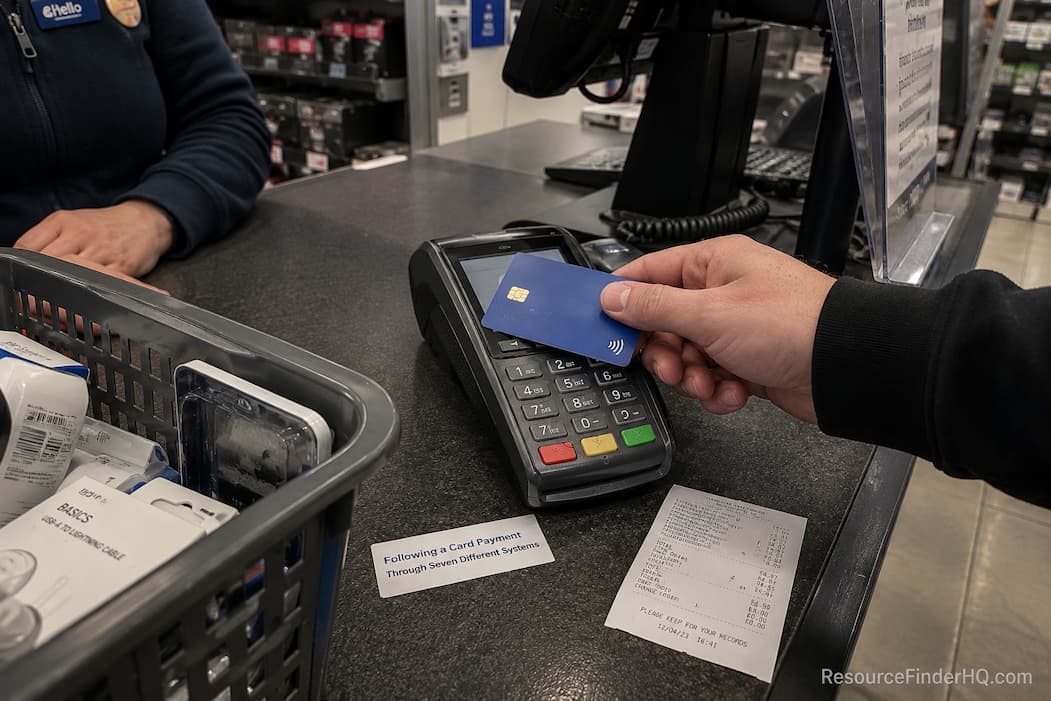
Customers tap their debit card against the payment terminal, hear a confirmation tone, and leave with their receipt in less than two seconds. For most, the transaction ends there. But in reality, this is merely the first step in a long journey.
Behind that simple tap or card insertion, countless independent systems exchange encrypted information, verify identities, assess risks, reserve funds, route requests, and generate settlement data. No single participant sees the entire transaction process from start to finish; each plays a specific role. Standardized communication protocols enable banks, payment processors, card networks, merchant payment systems, and fraud detection services to collaborate and process billions of transactions daily.
This is a carefully designed, layered structure. Modern payment systems are engineered to strike a balance between speed, reliability, security, and global compatibility. No longer is a single entity responsible for everything; instead, tasks are distributed across various specialized systems that can scale independently while adhering to uniform standards.
Understanding how these systems work helps explain why payments show a “pending” status, why refunds take days, why some payments are declined even when funds are sufficient, and why contactless payments remain secure despite the wireless transmission of data. This article guides you through the typical debit card payment process, from the moment a customer initiates a purchase to the final completion of the transaction. It reveals the seven key systems—often unknown to most people—that work together behind the scenes to facilitate virtually every successful payment.
A Payment Begins Long Before Money Moves
Although people often describe a purchase as “paying with a card,” the card itself doesn’t transfer money. Instead, it serves as a secure credential that allows participating financial systems to identify the customer, locate the correct financial institution, and request authorization.
Whether the customer inserts an EMV chip card, taps a contactless card, or uses a mobile wallet, the first interaction is simply the beginning of a communication process. At this stage, no money has actually changed hands. Instead, information begins moving between systems that must agree the transaction is legitimate before funds can eventually be transferred. Several pieces of information are assembled almost immediately, including:
- The purchase amount
- Merchant identification
- Terminal identification
- Currency
- Transaction timestamp
- Card credentials
- Security authentication data
These details form the transaction request that will travel through multiple financial networks over the next few seconds. The exact route varies depending on the country, payment network, issuing bank, merchant services provider, and payment technology involved. However, the overall architecture remains remarkably similar across much of the global payments industry.
The Seven Systems Behind a Typical Card Payment
Although dozens of supporting technologies may participate behind the scenes, most everyday card transactions rely on seven major systems working together.
| Stage | Primary System | Main Responsibility |
|---|---|---|
| 1 | Payment Terminal | Captures payment information securely |
| 2 | Merchant Point-of-Sale System | Creates and manages the purchase transaction |
| 3 | Payment Gateway or Payment Processor | Securely forwards transaction data |
| 4 | Card Network | Routes authorization requests between institutions |
| 5 | Issuing Bank | Verifies the cardholder and approves or declines the payment |
| 6 | Clearing & Settlement Systems | Transfer financial obligations between institutions |
| 7 | Merchant Bank (Acquirer) | Deposits settled funds into the merchant’s account. |
Each system specializes in one portion of the transaction rather than attempting to perform every task itself. This separation improves resilience, simplifies maintenance, and allows payment infrastructure to evolve without requiring every participant to redesign its entire operation. The following sections examine each stage individually.
Stage 1 — Payment Terminal: Where the Transaction Begins
Every electronic card payment starts at a payment acceptance device. Depending on the business, this may be a countertop terminal, a handheld reader, a self-service kiosk, an unattended vending machine, or an integrated checkout device. Despite their different appearances, modern payment terminals perform many of the same responsibilities before a transaction ever reaches a bank. Their first responsibility is securely reading payment credentials.
Depending on the payment method, the terminal may receive information from:
- An EMV chip
- A contactless NFC card
- A mobile wallet
- A magnetic stripe (where it is still supported)
Each method follows different security procedures, but they all aim to identify the payment credential without exposing sensitive information unnecessarily. Unlike older magnetic stripe technology, EMV chip transactions generate dynamic authentication data for each purchase. This means that even if transaction information were intercepted, it cannot simply be reused for another purchase.
Contactless transactions apply similar principles. Although customers experience only a quick tap, the terminal and payment credential exchange encrypted information within fractions of a second before the terminal proceeds. Modern terminals also perform several local checks before sending any information beyond the store. These may include:
- Reading card application data
- Verifying supported payment methods
- Checking terminal configuration
- Determining transaction capabilities
- Selecting security rules based on transaction type
Only after these preliminary steps are complete does the terminal prepare the authorization request.
More Than a Card Reader
Many people think of payment terminals as electronic replacements for old cash registers. Today’s devices are considerably more sophisticated. Modern terminals often contain secure hardware specifically designed to resist tampering. Sensitive cryptographic operations occur inside protected security modules that isolate confidential payment information from the rest of the device. Even software updates follow controlled deployment procedures to maintain compliance with payment security standards. Some terminals also support:
- Digital receipts
- Loyalty programs
- Multi-currency payments
- PIN verification
- Biometric authentication
- QR code payments
- Mobile wallet acceptance
- Offline transaction capabilities
Rather than acting as simple input devices, payment terminals have become intelligent endpoints capable of making numerous decisions before requesting payment authorization.
Why Security Starts at the Terminal
The earliest stage of the transaction is also one of the most important. If payment credentials are compromised before entering the secure payment ecosystem, every downstream system inherits that risk. For this reason, terminals implement multiple layers of protection designed to minimize opportunities for fraud. Several techniques commonly work together:
- Encrypted communication
- Secure key management
- Tamper detection
- Dynamic authentication
- Device certification
- Digital certificates
Each layer addresses different threats rather than relying on a single security mechanism. This layered approach illustrates a recurring principle throughout modern payment infrastructure: security is distributed across multiple independent systems instead of depending on one protective barrier.
Stage 2 — The Merchant Point-of-Sale System
Once the payment terminal captures the payment information, the transaction becomes part of a much larger retail workflow. The point-of-sale (POS) system manages considerably more than payments. It coordinates inventory, pricing, taxation, receipts, discounts, customer records, employee activity, and sales reporting while simultaneously communicating with payment infrastructure. For the payment transaction itself, the POS system assembles contextual information that financial institutions require to evaluate the purchase. Typical information includes:
- Purchase amount
- Merchant identification
- Store location
- Terminal identifier
- Transaction number
- Currency
- Date and time
- Product tax calculations
This business information combines with the secure payment information collected by the payment terminal before being forwarded to the next stage. Importantly, the POS system generally does not decide whether a payment should be approved. Its responsibility is to organize the transaction correctly and communicate with the payment service provider using standardized protocols.
The POS Has Become a Business Platform
Years ago, point-of-sale systems primarily recorded sales and printed receipts. Modern systems often function as operational hubs for entire businesses. A single POS installation may coordinate:
- Inventory databases
- Warehouse systems
- Customer relationship management platforms
- Loyalty programs
- Accounting software
- Online ordering
- Gift card management
- Employee scheduling
- Sales analytics
Because so many operational systems depend on accurate transaction records, payment data often becomes valuable far beyond the financial transaction itself. A successful purchase can automatically update stock levels, trigger customer rewards, generate accounting entries, and synchronize reports across multiple business applications—all within moments of the card being approved.
Stage 3—The Payment Gateway or Payment Processor
Once the point-of-sale system has prepared the transaction, the request enters the wider payment ecosystem through a payment gateway, a payment processor, or an integrated service that performs both roles. Although these terms are often used interchangeably, they describe different responsibilities within the payment flow.
A payment gateway acts as a secure communication bridge. It receives transaction data from the merchant, validates the request, encrypts sensitive information where appropriate, and forwards it to the correct payment network. A payment processor, meanwhile, manages the operational movement of transaction data between merchants, card networks, and financial institutions. Many modern payment providers combine both functions into a single platform, making the distinction less visible to merchants.
Before forwarding the transaction, these systems often perform a series of automated checks designed to improve reliability and reduce unnecessary processing. These checks may include:
- Confirming message integrity
- Validating merchant credentials
- Checking supported payment methods
- Formatting data according to network standards
- Performing initial fraud screening
- Identifying routing requirements
Only after these validations are complete does the transaction continue toward the appropriate card network.
Why Routing Matters
Not every payment follows the same route. The path depends on several factors, including
- The card brand
- The issuing bank
- The merchant’s acquiring bank
- The country where the purchase occurs
- The transaction currency
- The payment method
- Local payment regulations
Routing decisions happen almost instantly, yet they determine which financial systems will participate in authorizing the purchase. A customer buying coffee at a neighborhood café and another purchasing software from an international website may both use the same card, but their transactions can travel through very different processing paths before reaching the issuing bank.
Stage 4 — The Card Network
The card network serves as the communication backbone connecting thousands of financial institutions around the world. Rather than approving payments itself, the network acts as a highly specialized routing system. It identifies the correct issuing bank, forwards the authorization request, receives the response, and returns that response to the merchant through the same secure chain.
Without these standardized networks, every merchant would need individual technical connections with every bank that issued payment cards—a system that would be nearly impossible to manage at a global scale. Card networks maintain technical standards covering areas such as
- Message formatting
- Security requirements
- Transaction identifiers
- Communication protocols
- Error handling
- Network availability
These shared standards allow financial institutions from different countries and technology platforms to communicate consistently.
More Than Message Delivery
Modern card networks also support additional services that strengthen the payment ecosystem. Depending on the transaction, they may contribute:
- Token management
- Fraud monitoring
- Risk analysis
- Dispute support
- Transaction tracking
- Security verification
Many of these activities occur behind the scenes, remaining invisible to both customers and merchants while helping maintain the speed and reliability expected from modern electronic payments.
Stage 5 — The Issuing Bank Makes the Decision
After traveling through several systems, the authorization request finally reaches the institution that issued the customer’s payment card. This is where the most important decision occurs. The issuing bank evaluates whether the transaction should be approved, declined, or referred for additional verification. Contrary to a common misconception, this decision involves much more than checking whether sufficient funds or available credit exist. The bank may evaluate numerous factors simultaneously, including:
- Available account balance or credit
- Card status
- Spending patterns
- Transaction amount
- Merchant category
- Geographic location
- Security authentication results
- Recent account activity
- Internal fraud detection models
These evaluations occur within fractions of a second, allowing customers to receive an almost immediate response at checkout.
Approval Does Not Mean Money Has Moved
This is one of the most misunderstood parts of the payment process. When the terminal displays “Approved,” the funds have not yet been transferred to the merchant.
Instead, the issuing bank has authorized the transaction by confirming that the purchase meets its approval criteria and, in many cases, reserving the required funds or reducing the available credit accordingly. The actual movement of money takes place later during clearing and settlement. This distinction explains why customers sometimes see transactions marked as pending before they become fully posted to their account.
Stage 6 — Clearing and Settlement
Authorization completes the purchase from the customer’s perspective, but financial institutions still have significant work to perform. Clearing and settlement are often mentioned together, yet they describe two separate operational stages.
- Clearing focuses on exchanging financial information between participating institutions. During this process, transaction records are verified, matched, and prepared for final financial transfer.
- Settlement is the stage where financial obligations are fulfilled and funds move between institutions according to the agreed payment rules.
The simplified sequence typically follows this order:
| Stage | Primary Activity |
|---|---|
| Authorization | The issuing bank approves or declines the purchase. |
| Clearing | Transaction details are exchanged and reconciled |
| Settlement | Funds are transferred between participating institutions. |
| Posting | Accounts are updated with finalized transactions. |
This staged approach allows financial systems to process enormous transaction volumes efficiently while maintaining accurate accounting records.
Why Settlement Is Not Instant
Customers often expect every payment to move immediately because authorization appears almost instantaneous. In practice, settlement depends on many operational factors, including:
- Batch processing schedules
- Banking operating hours
- Cross-border processing requirements
- Currency conversion
- Merchant agreements
- Network processing windows
These operational considerations explain why merchants frequently receive deposited funds one or more business days after a purchase, even though customers left the store moments after the payment was approved.
Stage 7 — The Merchant Receives the Funds
The final stage occurs when the merchant’s acquiring bank receives the settled funds and deposits them into the merchant’s business account according to the agreed settlement schedule. Although this appears simple, the acquiring institution performs several additional responsibilities before the transaction is considered complete. These responsibilities often include:
- Reconciling settlement reports
- Calculating processing fees
- Preparing merchant statements
- Recording transaction references
- Depositing net proceeds
- Supporting future dispute resolution
At this point, the financial lifecycle of the original purchase has largely concluded, although associated records may remain available for months or even years for accounting, customer service, regulatory compliance, and dispute management.
Why Seven Independent Systems Work Better Than One
At first glance, involving seven different systems may seem unnecessarily complicated. However, this layered architecture offers significant advantages. Each participant specializes in a clearly defined responsibility rather than attempting to manage the entire transaction. This separation improves:
- Reliability
- Scalability
- Security
- Interoperability
- Operational resilience
- Regulatory compliance
It also allows different parts of the payment ecosystem to evolve independently. A merchant can upgrade its payment terminals, a bank can improve fraud detection, or a card network can introduce new security standards without requiring every other participant to redesign its infrastructure. This modular approach has helped electronic payment systems adapt to innovations such as contactless payments, mobile wallets, tokenization, and biometric authentication while maintaining compatibility with millions of existing merchants worldwide.
Common Misconceptions
“The merchant receives the money immediately.”
Approval and settlement are separate stages. Authorization confirms that the payment can proceed, while settlement transfers the funds later according to established processing schedules.
“The card network approves my purchase.”
Card networks route authorization requests. The issuing bank is generally responsible for deciding whether to approve or decline the transaction.
“A declined payment always means insufficient funds.”
Many factors can result in a declined transaction, including security rules, expired cards, temporary communication issues, incorrect authentication, or fraud prevention measures.
“Contactless payments skip security checks.”
Contactless transactions still rely on multiple security technologies, including cryptographic authentication, tokenization in many digital wallets, and fraud monitoring throughout the payment process.
Conclusion
The next time you see a payment completed in a second or two, remember that this visible transaction is just the beginning of a much larger process. Countless steps take place behind the scenes when you shop online. Terminals, payment systems, payment gateways, card networks, banks, and settlement infrastructure—all these systems work together to enable this seemingly simple transaction and ultimately ensure a secure and reliable financial exchange.
It is this mechanism that ensures electronic payments function efficiently and reliably worldwide. The entire ecosystem is not managed by a single institution; instead, responsibility is distributed across various specialized systems, each handling a small but crucial part of the process. Understanding these interconnections reveals that debit card payments are far more than a simple transfer of funds; rather, they represent a carefully orchestrated exchange of information, trust, and standardized processes that underpin the day-to-day operations of commerce.
FAQs
1. Do all debit card payments follow the same path?
The general architecture is similar, but routing can vary depending on the card issuer, country, payment type, merchant settings, and the relationship with the bank.
2. Why does it sometimes take days for a transaction to be confirmed?
Pending transactions usually mean that authorization is complete, but clearing and settlement are still underway. Processing times vary depending on the bank and the payment source.
3. Are payment gateways and payment processors the same thing?
Not always. A gateway’s primary role is ensuring secure communication between merchants and the payment infrastructure, whereas a processor is responsible for the operational processes of handling transaction data. Many providers offer both services on the same platform.
4. Why do refunds usually take longer than purchases?
Refunds are a different financial process. They go through authorization, processing, clearing, and settlement stages before the issuing bank deposits the funds into the customer’s account.