
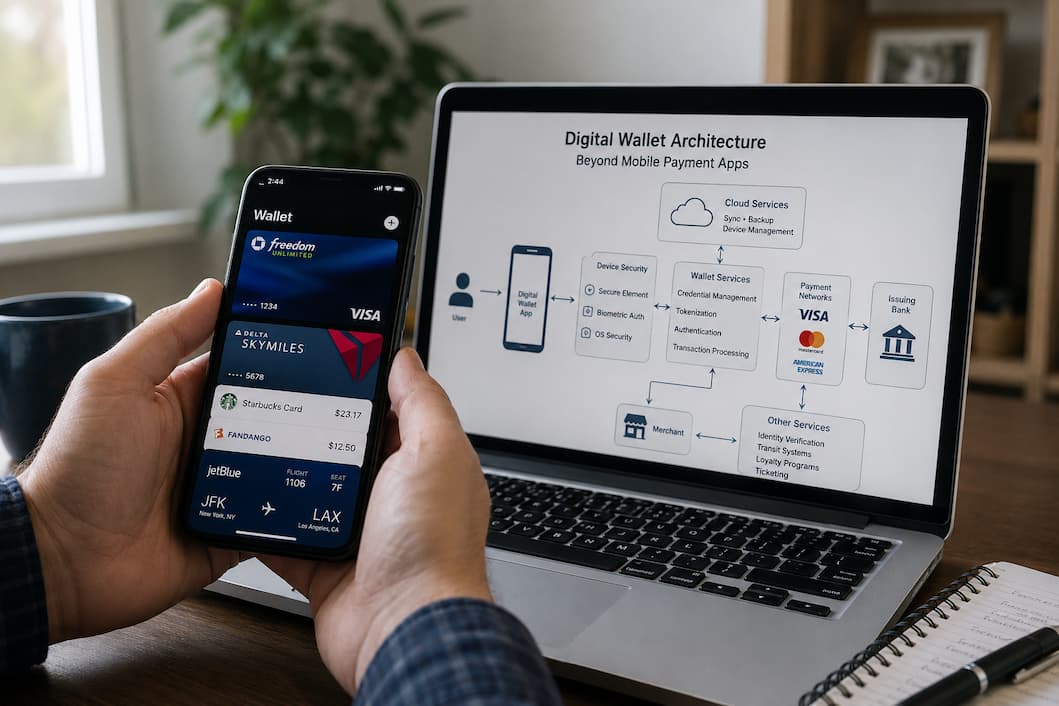
Many people view a digital wallet simply as a feature on a smartphone that is used by holding the device near a payment terminal. It works much like a contactless bank card: a quick tap to pay, and a confirmation message appears on the screen. This simplicity makes it the most common way to use a digital wallet. A more advanced application involves tapping your phone at the checkout. Modern digital wallets can be used for identity verification, credential management, security authentication, transit systems, loyalty programs, online shopping, and many other digital services unrelated to payments.
To understand the design, you need to look beyond just the mobile app. The app is merely a channel through which customers interact with you. The wallet’s operation encompasses security features, cloud services, communication protocols, payment data, authentication methods, and connectivity to financial networks. It is easier to grasp why a digital wallet is more than just a payment method if you separate the visible application from the underlying infrastructure.
The Wallet Is an Interface, Not the Entire System
Many misconceptions about digital wallets stem from their appearance. When you open the app, it displays your payment cards, transaction history, membership details, and sometimes even your ID. This creates the impression that the app holds all the user’s digital data, leading people to assume that it stores all critical information.
In reality, however, the app serves primarily as a management layer. Depending on the platform and service, payment data may be secured by encrypted operating system components, secure hardware, or a cloud infrastructure that synchronizes data across trusted devices. The payment network confirms identity during transactions but does not share private financial data with companies. An identity verification system confirms the identity of the digital wallet’s owner. What appears to be a simple set of virtual cards is actually the final component of a larger architecture designed to balance ease of use with security.
Digital Wallets can Support a Wide Range of Services
Moreover, digital wallets can typically interact with various systems, whereas a standard wallet merely stores data until it is needed. Wallet applications, device operating systems, secure hardware, payment networks, issuing banks, identity verification services, and merchant payment infrastructures can all communicate with one another simultaneously. Although each component performs a specific function, the entire process appears seamless to the user.
Thanks to this unified design, wallets offer far more than just a place to store money. Applications can use encrypted credentials—securely stored on the device—to retrieve airline boarding passes, display public transport cards, or verify online accounts, for example. These functions rely on various technologies, yet the wallet interface straightforwardly connects them.
Payment Credentials Are Rarely Original
The design of digital wallets changed when payment card details could no longer be stored in a reusable format. Many wallet platforms use tokenized data instead of actual payment account details, eliminating the need to expose card numbers.
This distinction is crucial because wallets do far more than just hold credit card details; they ensure both the security of payment data and the smooth execution of legitimate transactions. Tokens operate within a controlled ecosystem and undergo additional security checks before a transaction takes place. Consequently, stealing the value of tokens during a payment is often less rewarding than stealing actual account details. Tokenization transforms the wallet from a mere repository for digital items into a secure environment for data management that complies with modern payment security standards.
Architecture for Multiple Devices
Unlike earlier discussions that focused primarily on smartphones, the modern digital wallet ecosystem encompasses multiple devices. Wallet environments work on smartwatches, tablets, laptops, and other connected devices, ensuring consistent security rules and data across all of them. This expansion reflects a growing trend toward ecosystems that users can securely access from any trusted device.
Multi-device support introduces architectural challenges that physical wallets never faced. Administrators must be able to lock lost or stolen devices without affecting user accounts, synchronize passwords without compromising private data, and verify identities across diverse hardware types. To address these issues, wallet solutions combine local security with cloud-based account management, creating a design that works across all devices.
Layers Work Together for Security
There are several ways to secure digital funds. Wallets can be protected using fingerprint scanners, facial recognition systems, encrypted storage, or tokenized payment data. However, no single method can guarantee a wallet’s security on its own. A multi-layered architectural design ensures that, even if one component fails, login credentials across the entire ecosystem remain secure.
This layered approach also explains why two digital wallet platforms might look similar yet use different technologies to implement their functionality. Some focus on secure hardware, others on cloud-based credential management, and many on both. Regardless of the approach, the goal remains the same: to provide authorized users with quick access to their passwords while preventing others from easily obtaining them.
Digital Wallets Are Increasingly Serving as a Hub for Identity Verification
While users highly value payment functionality, they are also increasingly using digital wallet platforms to securely store identity data. Government agencies, transport companies, universities, businesses, and employers are exploring ways to issue credentials that can be linked to payment methods, replacing the need for bank cards or paper documents.
From a technical standpoint, the process is far more complex than simply displaying an ID card on a screen. Digital identities must enable owners to prove specific facts without disclosing irrelevant personal information. For instance, a company might only need to verify that a customer meets a certain age requirement, without needing to know their specific address or date of birth. As wallet designs continue to evolve, verifying credentials during interactions could become easier while minimizing the sharing of personal information. As digital identity standards evolve, trusted credential management institutions capable of providing diverse verification information for various situations are becoming increasingly important.
Online Purchases Differ Architecturally
E-wallets can be used for both online and offline payments, but the methods differ significantly. Offline payment terminals use short-range wireless technology to communicate with e-wallets. Online shopping, on the other hand, relies on a secure internet connection and user-friendly programming tools to exchange information with websites or apps.
Despite these differences, the goal remains the same: ensuring the authenticity and reliability of user identities, protecting payment data, and providing merchants with the information needed to complete transactions—all while preventing the leakage of financial details. Whether you are shopping in a physical store, via a mobile app, or in a web browser, the same authorization page appears.
The versatility of modern digital wallets makes them crucial for omnichannel commerce. They can replace separate payment systems for different scenarios and adapt to a wide range of situations.
Strong Encryption Alone is Not Enough to Build Trust
Encrypting your digital wallet is important, but it is only one part of building trust. Financial institutions and digital wallet providers ensure that users registering for payment methods have the proper authorizations before adding personal information. Verification methods may include biometrics, banking system verification, one-time codes, or other security measures, depending on the website and local regulations.
Merely gaining trust is not enough. Digital wallet platforms are responsible for software updates, security certificates, authentication systems, and device integrity checks to maintain the trust of the user community. If a device is lost or stolen, the design allows payment data to be removed—either temporarily or permanently—without affecting the underlying bank accounts. Since the actual payment account differs from the digital copy, a digital wallet offers a secure way to store financial information.
Why Digital Wallets Are About More Than Just Payments
As companies increasingly issue digital identities, the use cases for digital wallets extend far beyond simply storing money. They can also securely store information such as event tickets, hotel room keys, work documents, transit passes, medical licenses, and educational certificates.
From an architectural standpoint, this expansion makes sense. Strong authentication, encrypted storage, secure communication, and the controlled exchange of credentials are all highly valuable features for a wide range of digital identity systems. Companies can utilize a reliable architecture that is easy for customers to understand, without needing to develop separate applications for each type of credential. In this way, a digital wallet evolves from a mere payment tool into a secure repository for trusted digital information.
Comparing a Payment App and a Digital Wallet Architecture
| Feature | Simple Payment App | Digital Wallet Architecture |
|---|---|---|
| Primary purpose | Complete payments | Manage multiple trusted credentials |
| Stored information | Usually payment methods only | Payment methods, identity, tickets, passes, loyalty credentials and more |
| Security model | Focused mainly on payment protection | Multi-layer security supporting different credential types |
| Integration | Limited financial services | Financial institutions, merchants, identity providers, transit systems, and other trusted services |
| Long-term role | Payment convenience | Secure digital credential ecosystem |
Beyond the Payment Process
Digital wallets today do far more than just facilitate payments via a mobile app. The client-side payment interface is just the visible part of a larger system that secures credentials, verifies identities, coordinates trusted services, and connects securely to both financial and non-financial systems.
As the digital ecosystem evolves, wallet design is becoming increasingly important, as it offers a unified way to manage trust in services. While payments remain a primary use case, the utility of digital wallets now extends well beyond them. The goal is to enable individuals to securely store verified digital data, use it when needed, and control how that data is shared online.
FAQs
1. Are all mobile payment apps digital wallets?
Not necessarily. Some apps are used exclusively for payments, whereas others handle various digital data types. The underlying architecture and supporting services are more significant distinguishing features of a digital wallet than the app’s visual interface.
2. Are there digital wallets that do not require an internet connection?
Certain functions may remain operational under specific conditions, depending on the platform and the credentials involved. However, adding credentials, synchronizing data, and authorizing various types of payments all require secure connections to other systems.
3. Why can the same payment card be used on multiple devices?
Most e-wallet services do not duplicate actual card details. Instead, they generate a unique digital ID for each authorized device. This allows for individual management, ensuring control even if a device is lost, replaced, or removed from the account.
4. Will physical wallets gradually disappear in favor of digital wallets?
Not at the moment. Although digital wallets are constantly improving, physical cards, identity cards, and other forms of identification remain crucial in many situations. People likely live in the same environment and choose the lifestyle that best suits their circumstances.
5. Do all digital wallets store information in the same way?
No, digital wallet providers use different architectures, security methods, and approaches to managing credentials. The user experience may be similar across different platforms, but the implementation can differ significantly.