
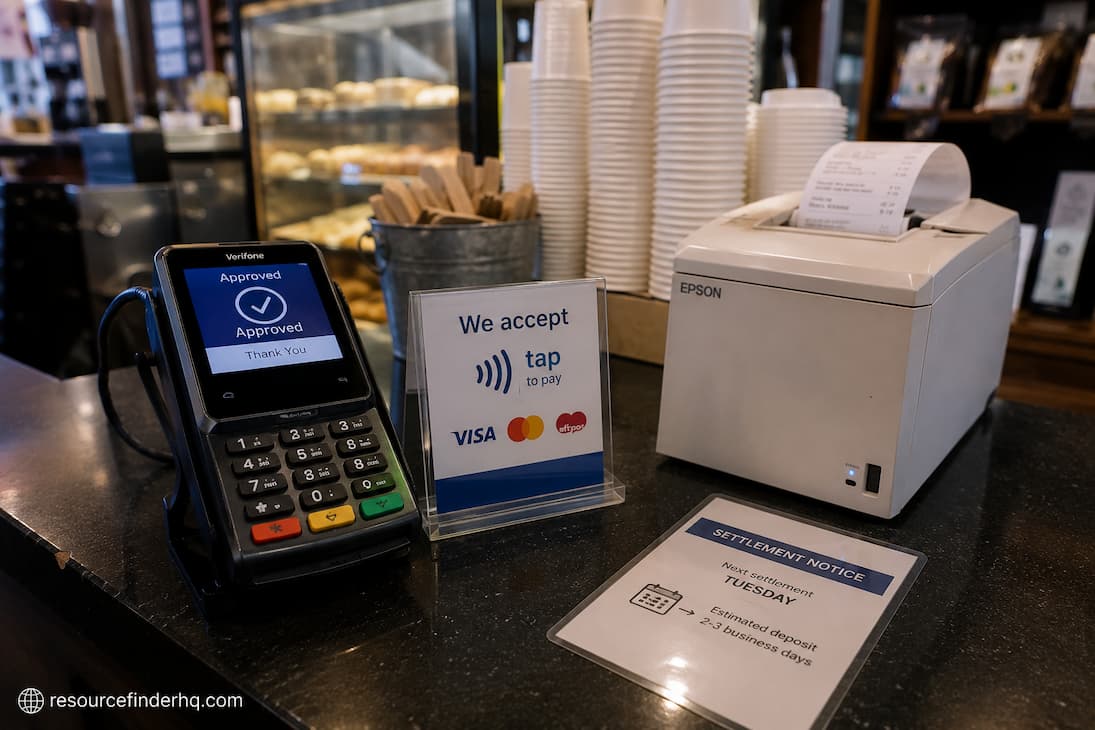
After scanning their card, the buyer immediately receives a payment confirmation and leaves, assuming the transaction is complete. From the customer’s perspective, the transaction is finished: the bank has approved the payment, the merchant has finalized the sale, and the receipt shows that everything has gone smoothly. However, the funds have not yet actually been deposited into the merchant’s bank account. Settlement—the step between payment authorization and the actual transfer of funds—is far less visible than the payment processing itself.
Settlement converts accepted transactions into actual funds that the merchant can use. Many people do not realize that settlement, despite taking place behind the scenes, has a significant impact on day-to-day business operations. Settlement schedules help retailers track cash flow, pay suppliers, manage employee salaries, and replenish inventory. Even businesses with daily revenues of thousands of euros require careful planning when funds do not arrive immediately after every purchase but rather according to a settlement schedule.
Authorization Confirms the Payment, Settlement Moves the Money
People often confuse payment settlement with payment authorization and money transfer because these processes appear to happen simultaneously. In reality, they represent distinct stages in the overall payment cycle. Authorization answers a very simple question: Can this transaction proceed, based on the paying bank’s assessment of the account? Settlement addresses a completely different question: When and how are funds from a transaction transferred from one financial institution to another?
This distinction becomes easier to understand once you know the roles of the various participants. During the authorization phase, the issuing bank holds or confirms the availability of funds. Subsequently, the acquiring institution, the payment network, and the settlement system arrange the transfer of funds according to standard banking procedures. Because these processes happen very quickly, customers often do not notice this difference, though businesses do when checking their bank balances.
Why Businesses Rarely Receive Individual Deposits for Every Sale
Imagine a busy Saturday where a local bookstore processes 200 credit card payments. If every transaction corresponded to a separate bank deposit, the merchant would spend a great deal of time reconciling incoming transfers with sales records. As the number of transactions grows, financial administration becomes increasingly complex.
In practice, payment systems typically group all accepted transactions before settlement. Depending on the agreement between the merchant and the payment service provider, these grouped transactions may be settled according to a pre-established schedule rather than individually. This allows banks to streamline accounting processes, reduce costs for businesses, and accelerate the processing of high transaction volumes without altering how customers pay their bills.
For businesses, the final bank deposits usually represent dozens, hundreds, or even thousands of sales, rather than just a single transaction. Understanding this distinction is crucial, as the amounts appearing in a business’s account reflect when the settlement process was completed, not when each customer made their payment.
Processing Times Are Not Determined Solely by the Calendar
It is easy to view processing cycles as daily routines, but the exact dates depend on numerous operational and financial factors. When funds arrive can depend on business agreements, bank operating hours, payment methods, transaction deadlines, weekends, public holidays, and the specific procedures of banks in your region. Consequently, even companies with the same transaction volume may experience significantly different processing times if they operate in different sectors or use different payment providers.
For businesses that need to track daily operating expenses, these differences go far beyond mere administration. Understanding when funds arrive helps companies improve inventory planning, pay suppliers, schedule shifts, and manage short-term cash flow. As businesses grow and transaction volumes increase, understanding processing times becomes more than just an accounting task; it becomes a crucial component of expenditure planning.
Processing Contributes to the Stability of the Payment System
Every day, banks, card networks, payment processors, and merchants across various regions use modern payment systems to process vast numbers of transactions. Coordinating the flow of funds for every accepted payment requires a balance between speed and consistency. Settlement cycles—through a structured approach—ensure consistency by allowing institutions to reconcile records, define payment obligations, and execute accurate transfers.
From a merchant’s perspective, this process may simply resemble a standard deposit into the business account. Various departments reconcile transaction data, balance payment obligations, and execute the necessary transfers to ensure that funds reach the correct accounts. Settlement is therefore not merely a waiting period; it is a crucial component for the smooth functioning of large-scale digital payment systems.
Settlement Timing Depends on More Than the Calendar
Strong sales do not always translate into the immediate availability of liquid assets. A business might generate high sales over the weekend, yet find its working capital account balance lower than expected at the start of the following week because many payments are still awaiting processing. This discrepancy is particularly significant for companies that require stable cash flow to purchase inventory, pay suppliers, and cover daily operating expenses.
For instance, a store might process thousands of dollars in credit card transactions in a single day during a holiday promotion. Although these sales represent revenue, the payment service provider may not finalize the settlement agreement until the merchant receives the actual funds. Consequently, financial managers closely monitor sales performance and expected settlement dates, as both factors influence the company’s day-to-day decision-making.
Settlement Supports Stability Across the Payment Ecosystem
Not all digital payment processing workflows are the same. Depending on the bank, the payment network, and regional infrastructure, card payments, interbank transfers, digital wallets, and real-time payment systems may operate differently. Customers often perceive all these payment methods as equally fast, yet the actual time the funds spend in transit can vary.
For this reason, companies typically evaluate various payment methods from both the customer’s perspective and the operational perspective of the payment method itself. Although a specific payment method might make the checkout process very convenient, the mechanics of fund settlement may differ from those of other methods. When processing multiple types of payments, companies generally analyze settlement reports to understand when they can expect the various amounts to arrive.
Accurate Settlement Data is Essential for Smooth Reconciliation
Receiving a deposit is just one part of cash management. Businesses must also ensure that the amount received matches the transaction amounts processed during the settlement period. This process, known as reconciliation, ensures complete consistency between payment data, accounting systems, and bank statements.
Merchants typically do not verify each customer payment individually; instead, they use settlement reports. These reports provide an overview of all completed transactions, fees, adjustments, refunds, and other changes affecting the final deposit. They offer a clear record, enabling the finance team to identify discrepancies when necessary and maintain accurate accounting records without having to check each payment individually.
Understanding the Difference Between Authorization and Settlement
| Payment Authorization | Merchant Settlement |
|---|---|
| Confirms whether the payment can proceed | Transfers approved funds to the merchant |
| Happens during checkout | Occurs after approved transactions enter the settlement process |
| Evaluates the payment account | Completes the financial movement between participating institutions |
| Visible to the customer through an approval or decline | Mostly visible to the merchant through deposits and settlement reports |
Faster Settlement Times Do Not Mean Less Control Over Funds
Many payment processors now offer accelerated settlement services, reducing the time merchants have to wait for payments. While these services make funds available sooner, they do not eliminate the financial controls that ensure the security of the payment environment. Transactions still require operational processes, compliance checks, and reconciliation to guarantee accurate transfers.
The growing popularity of fast settlements is not due to the disappearance of settlement methods, but rather the continuous evolution of payment technology. Financial institutions still strive to strike the optimal balance between speed and reliability. This is because transferring funds quickly is pointless if the data cannot be reconciled correctly or if it increases operational risk. Consequently, the goal of modern payment systems is to reduce settlement times while maintaining the accuracy and security expected by merchants, banks, and payment service providers.
FAQs
Does an accepted debit card payment mean the merchant has received the funds?
No; approval merely indicates that the transaction is legitimate and valid. The actual transfer of funds usually takes place later in the settlement process.
Why do merchants sometimes receive one large deposit instead of multiple smaller ones?
In most cases, payment service providers bundle all eligible transactions within a settlement cycle into a single deposit. This simplifies accounting and makes it easier to track large numbers of individual transfers.
Do settlement times vary by merchant?
Yes. Settlement times depend on various factors, such as the seller’s agreement with the payment service provider, accepted payment methods, banking procedures, processing times, and the local financial infrastructure.
Is the refund process the same for all sellers?
Refunds are processed through specific financial systems and may appear as adjustments in settlement reports. The exact timing depends on the customer’s payment method, the payment service provider, and the financial institution involved.
Settlement Is the Bridge Between Sales and Available Funds
When a payment is approved, a financial obligation is created. Settlement is the process of transferring funds to the seller to fulfill that obligation. While customers generally do not notice this process, merchants rely on it daily, as it provides insight into when revenue becomes available for operating expenses, purchasing, and financial planning.
Understanding the settlement phase helps you grasp how digital payments work beyond the checkout page. This article explains why a successful sale and the actual receipt of cash are not always the same thing, and why merchants need to monitor settlement reports just as closely as sales figures. In a payment system built on speed and trust, settlement remains a crucial link that subtly connects completed transactions with a business’s actual financial resources.