
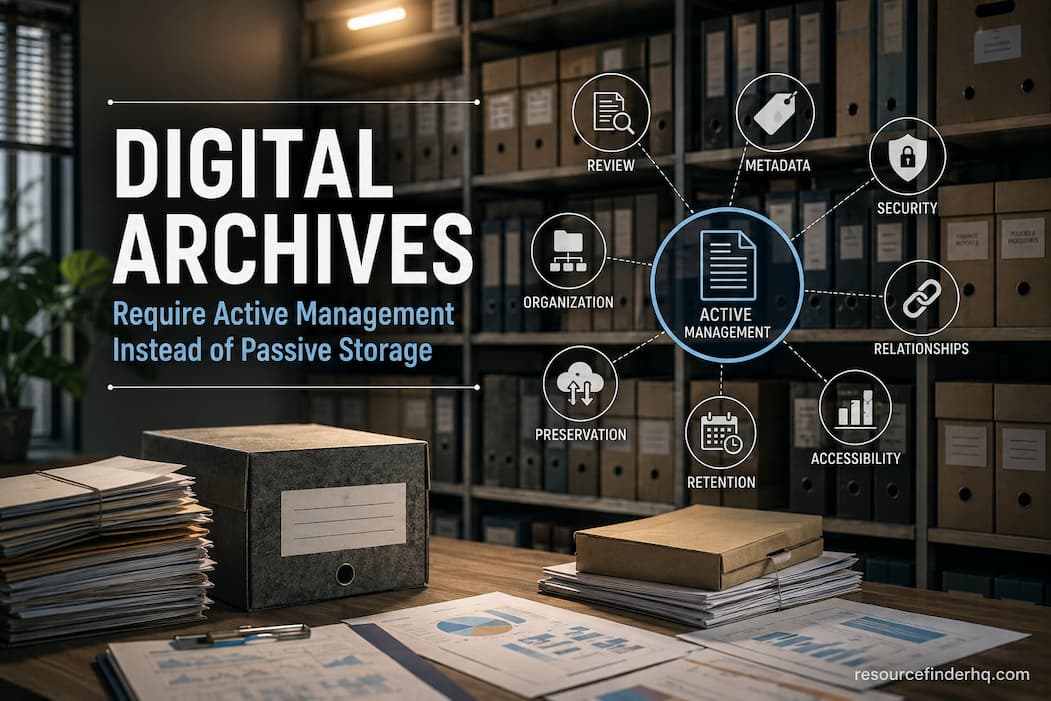
The hard part is over if you save digital data. Storage devices keep getting bigger, cloud platforms add space in minutes, and backup systems automatically keep copies of important files. Due to their simplicity, digital archives may seem to self-manage. Often, the opposite is true. Larger archives take more care to stay accurate, searchable, secure, and valuable.
Unmanaged archives seldom fail overnight. Instead, quality degrades gradually. Information gets harder to find as duplicates, old papers, and incorrect classifications spread across departments. These issues may seem minor, but together they lower archive confidence. Users spend more time confirming information than using it, defeating the goal of retaining it.
Archiving Is Not Just Keeping Everything
Information storage and archive management are related but different. Archives consider the long-term value, structure, accessibility, and administration of digital materials, while storage preserves them. Imagine a corporation that stores all its documents in one cloud account without scrutiny. Nothing has been lost, but employees may have trouble distinguishing active from obsolete documents, finding approved copies, and trusting older records. Because information has been preserved without organization, the archive grows larger every year but becomes less useful.
An actively managed archive treats stored data as a resource that needs continual care. Documents are inspected, classifications are updated, outdated material is handled per policy, and organizational structures alter with company demands.
Information Changes After Storage
Many records are valuable for years, but they rarely remain unchanged. Departments, products, regulations, and technologies change. An old document may be accurate, but you may need to change its classification, protection, or connection to relevant material.
A technical manual for one product line may become part of a broader product family. The document may not need major changes, but metadata, classification, cross-references, and access permissions may need to be updated to reflect its new archive status. Active archive management considers context when preserving information. Even correct records can become difficult to comprehend without periodic maintenance because their organizational framework no longer matches reality.
Activities for Digital Archive Health
Regular practices in well-maintained archives include:
- Consistent classification review.
- Metadata updates when information changes.
- Eliminating duplication.
- Verifying access rights.
- Maintaining search indexes.
- Checking associated record linkages.
- Following retention and archive policies.
These activities ensure that stored data is useful rather than just storage.
Preservation Includes Tech-change Protection
Digital information relies on changing technologies. Cloud services add new features, file formats expire, and software systems end of support. An archive that ignores these modifications may include technically preserved but increasingly difficult-to-access material.
Thus, organizations plan for information retention and usability. Before older technologies become unusable, files can be moved to newer storage platforms, converted to widely supported formats, or transferred to updated archive systems. Access is as vital as information, thus these changes must be planned carefully. Active management knows digital preservation goes beyond data loss. It also guarantees that future users can open, understand, and trust archived data despite technological change.
Good Archives Inspire Confidence
People trust archives because they contain reliable information. Users lose trust in the archive and look elsewhere for solutions if they continually find outdated records, contradictory versions, broken references, or missing context. It takes more than information to build confidence. Maintaining quality over time is key. Regular reviews, clear governance, consistent organization, and deliberate preservation techniques create an archive that people trust when making crucial decisions based on reliable historical data.
Actively managed archives serve more than long-term storage. It provides dependable organizational knowledge for research, operations, compliance, and decision-making long after the original papers were created.
Archive Quality Needs Regular Review
Even well-organized digital archives evolve from their original norms. New departments introduce various workflows, software platforms create new file types, and employees adopt shortcuts that may violate information management rules. Without periodic inspection, these tiny changes aggregate, making the archive less consistent.
Regular reviews detect these flaws before they propagate throughout the collection. Administrators may find records with wrong classifications, missing metadata, duplicate versions in different locations, or folders that no longer represent the organization’s structure. Early intervention is easier than large-scale cleanup years later. Archives should be reviewed for more than just error correction. It also allows organizations to verify that their procedures promote information creation, sharing, and retrieval.
Retention Policies Make Archives Useful
An effective archive doesn’t need to save everything forever. diverse records have diverse usefulness, legal importance, and operational value in many situations. Keeping everything permanently may increase storage costs, complicate searches, and make it difficult to find important records.
Structured retention procedures address this issue. Organizations determine how long various types of information should be active, when they should be stored, and when they should be erased according to needs. Not just archive size reduction. It ensures that the collection retains business, historical, legal, and operational value while avoiding clutter that makes retrieval harder.
Active Management Compared With Passive Storage
| Passive Storage | Active Archive Management |
|---|---|
| Focuses on preserving files | Focuses on preserving useful information |
| Information may remain unchanged indefinitely | Records are reviewed throughout their lifecycle |
| Limited attention to organization after storage | Metadata, classifications, and relationships are maintained |
| Problems often discovered only during retrieval | Issues are identified through regular reviews |
| Emphasizes capacity | Emphasizes accessibility, accuracy, and long-term usability |
The difference lies in treating an archive as a living information system rather than simply a place where files are kept.
Relationships Between Records Need Ongoing Attention
Individual documents typically make sense only with connected information. Meeting notes, approval records, design specifications, implementation plans, and final reports can accompany project proposals. If these relationships disappear, users may find one document without understanding its context.
Active archive management preserves connections. Links, references, and metadata can be changed to reflect the archive’s current arrangement as documents move across systems or organizational structures change. This keeps knowledge relevant as technology changes. Maintaining relationships improves collaboration. Instead of putting together isolated documents from numerous locations, employees examining older projects may follow related records, saving time and uncertainty.
Warning Signs of Archive Issues
Several indicators suggest that active maintenance would enhance a digital archive.
- Duplicate files are common because records are hard to locate
- Search results are outdated or inconsistent.
- Similar records often have incomplete or inconsistent metadata.
- Classification requirements vary per department.
- Organizational roles no longer match access rights.
- Lost context makes historical records difficult to interpret.
Recognizing these indications early helps organizations update the archive before confidence in its contents declines.
Automation Assists Management
Modern archive solutions can automatically classify documents, apply retention schedules, synchronize information, monitor storage health, and provide reports. These features greatly decrease repetitious administrative effort, especially in businesses with millions of records.
But automation works inside the framework people build. Automated procedures will exploit poorly planned retention regulations and conflicting classification standards. Developing governance principles, assessing exceptions, and modifying archive processes to business needs requires human oversight.
Automation and careful maintenance make the best digital archives. The program handles routine chores, but strategic decisions still require human judgment and organizational knowledge.
Constant Care Creates Value
Digital archives work best as dynamic information systems rather than permanent storage. Every document preserved today joins a bigger collection that will grow, change, and inform future decisions. That collection needs intentional organization, regular review, accurate metadata, consistent governance, and context preservation, not just more storage.
Active archive management will ensure that historical records stay useful as businesses generate more digital information. Reviewing, maintaining, and adapting an archive over time turns it into a reliable source of knowledge that supports operations, compliance, research, and informed decision-making for years.
FAQs
1. Why isn’t file storage enough for digital archives?
Archive information requires organization, accurate metadata, access controls, retention policies, and regular maintenance to remain useful.
2. How often should digital archives be checked?
No schedule is universal. Review frequency relies on information volume, regulatory requirements, operational needs, and archive modification frequency.
3. Does cloud storage replace archive management?
No. Cloud platforms provide reliable storage and accessibility, but they do not automatically solve classification, governance, metadata quality, or long-term information organization issues.
4. What is passive archive management’s most significant risk?
Over time, material might become hard to find, outdated records may persist alongside current ones, organizational consistency degrades, and users lose trust in the archive.