
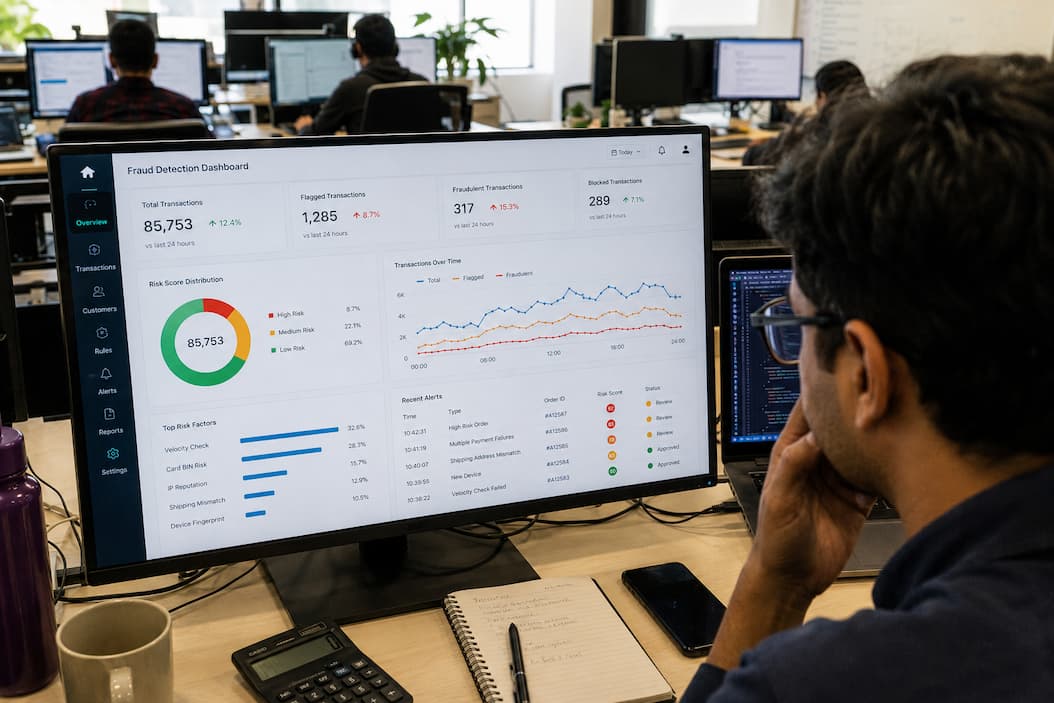
Online payment fraud is often viewed as a battle between criminals and banks. Criminals steal bank cards, transaction details are sent to the issuing bank, and a sophisticated fraud detection system decides whether to approve or reject the transaction. While this process does exist, it overlooks a crucial step. Many payment requests pass through multiple layers of checks—designed to detect suspicious activity—before the bank approves them.
This shift reflects the evolution of digital commerce over the past twenty years. Fraud is no longer limited to counterfeiting bank cards or stealing payment details. The payment details themselves may be legitimate, as criminals can use genuine bank card information (obtained through data breaches, compromised user accounts, or phishing attacks). Consequently, modern fraud prevention focuses less on verifying the authenticity of bank cards and more on determining whether the entire transaction aligns with the behavior of a legitimate user. This assessment typically begins the moment the consumer interacts with the merchant’s website, rather than when the payment details reach the bank’s network.
The Checkout Page Reveals Far More Than Just Payment Details.
When customers check out on e-commerce websites, they see a basic page. They enter their name, shipping address, and payment details and confirm their order. Behind this familiar interface, however, the merchant’s algorithms monitor information to determine whether a transaction matches normal purchasing behavior. Most algorithms are not designed to identify specific customers, and this information is not used in isolation. Instead, it contributes to a more comprehensive understanding of the transaction itself. Modern anti-fraud platforms can link orders to past purchase history—such as whether there have been multiple payment attempts within a short period or even if several customer accounts originate from the same technical environment. They can also assess whether the shipping address has recently been linked to disputed transactions or if the purchase deviates significantly from the customer’s usual buying habits. Individually, these nuances may seem insignificant. However, they provide background information that payment cards alone cannot offer, giving merchants the data needed to identify transactions requiring further scrutiny before the payment process is even completed.
Merchant-Side Verification Has Become a Crucial Line of Defense
If all payment requests were sent directly to issuing banks, many online businesses would be exposed to unnecessary financial risks. Issuing banks are primarily concerned with whether the cardholder’s account has sufficient funds to cover the purchase and whether the transaction meets the bank’s criteria. Banks do not always possess the specific merchant-related information needed to determine if an order is unusual.
Imagine running an online store that primarily sells home electronics to customers in rural areas. A new customer orders thousands of euros’ worth of goods, requests priority international shipping, and tries several different bank cards before the payment finally goes through. The card might belong to a legitimate consumer with sufficient credit, yet the entire order could still fit a typical pattern of fraud. Many businesses initially view these external factors as security measures rather than bank authorization. Depending on the risk level, the order may be processed via the standard workflow, held pending further verification, or even intercepted before an authorization request is sent.
Fraud Detection Relies on Context, Not Individual Warning Signs
One of the most significant shifts in payment security is the move away from rigid, rule-based solutions. Early fraud prevention tools relied on static rules—such as blocking transactions above a certain amount or flagging transactions from a specific region. While these systems could identify obvious risks, they also generated a high number of false positives, as normal consumer behavior often met these criteria.
Modern systems no longer focus on isolated events but rather on the correlation between multiple data points. A large purchase in an unfamiliar region that aligns with a customer’s travel and purchasing history is not necessarily suspicious. Conversely, a low-value order that forms part of an unusual pattern of account activity might carry a higher risk score. This contextual strategy enables retailers to focus their attention on transactions that deviate from established norms, while minimizing disruption for legitimate consumers.
| Traditional Rule-Based Screening | Context-Aware Fraud Analysis |
|---|---|
| Evaluates individual conditions | Evaluates combinations of signals |
| Same rule applies to every customer | Considers customer and transaction history |
| More likely to generate false positives | Better at distinguishing unusual from suspicious behavior |
| Limited adaptability | Continuously improves as new fraud patterns emerge |
Decisions Are Often Based on Probability Rather Than Certainty
Fraud prevention systems do not prove a transaction is fraudulent before it reaches the bank; instead, their goal is to determine the likelihood that a payment requires further investigation. Most transactions cannot simply be categorized as ‘safe’ or ‘fraudulent.’ They fall somewhere in between, requiring the system to analyze vast amounts of information before making further recommendations.
That is why many companies use risk scores rather than simple approve/reject decisions. Low-risk transactions can be approved instantly without delay, while others may require additional verification or manual review. Rather than striving for absolute certainty—which would create unnecessary obstacles for the vast majority of legitimate consumers—companies protect themselves against increasingly sophisticated fraud by calculating probabilities.
The Technology behind Modern Fraud Detection
Guidelines for fraud analysts represent only one component of today’s fraud protection systems. Major payment platforms process millions of transactions daily, generating far more data than any human analyst could manually review. To handle this huge workload, many institutions add statistical models and machine learning algorithms to traditional rule-based checks, constantly comparing new transactions with historical patterns.
However, this does not mean computers can make arbitrary judgments. While fraud methods constantly evolve, human analysts must still set priorities, assess situations, and adjust systems. The technology simply helps identify correlations that would be difficult for humans to detect. For example, a fraud detection system can identify subtle similarities between a seemingly normal transaction and hundreds of previously investigated transactions, even if the transaction itself contains no suspicious elements. This allows retailers to respond to emerging fraud trends more quickly than if they relied solely on manual review.
Device Intelligence Provides Additional Contextual Information
Payment cards are only part of the story. The device used to place an order can provide retailers with further clues, helping them determine whether a transaction requires closer scrutiny. This method is known as device intelligence or device fingerprinting; it focuses on the device’s characteristics rather than the person operating it.
The system considers multiple technical attributes—not just a single identification code—to build a consistent user profile. If the same device suddenly appears across multiple customer accounts, repeatedly attempts (and fails) to make payments, or has a history of fraudulent activity, this information will influence the overall risk assessment. Conversely, if a device has a long history of successful purchases and other transaction details align with past activity, that device can positively influence the assessment results.
Why Legitimate Customers Are Sometimes Asked to Verify a Purchase
Most people have encountered payment situations requiring extra security measures, even when they believe the transaction is legitimate. Retailers might request additional verification data. Orders could be temporarily held before shipment. Banks might issue one-time verification codes. While these situations can be inconvenient, they often simply reflect anti-fraud systems responding to suspicion rather than detecting actual illegal activity.
Businesses must balance security with the customer experience. If retailers rejected every suspicious transaction, many legitimate customers would abandon their shopping carts and buy from other retailers. Conversely, if retailers allowed every transaction to proceed without further verification, they could incur unnecessary losses. Consequently, anti-fraud systems often adopt a compromise: stricter verification is required only when the provided information is suspicious enough to warrant a second check.
Fraud Prevention Does Not End with Authorization
Obtaining authorization approval from the issuing bank is a significant step, but it does not mark the end of fraud monitoring. Many merchants continue to screen orders during the shipping process, particularly for high-value items that are easy to resell or frequently targeted by organized fraud rings.
Seemingly flawless, high-value orders can still face delivery delays as further information comes to light. Other merchants may have flagged the shipping address as fraudulent, or customer service might discover irregularities while reviewing shipping details. In rare instances, companies proactively cancel orders—even those with payment authorization—because the overall risk profile may have changed before the goods leave the warehouse. This continuous monitoring can prevent irrecoverable losses after delivery.
Fraud Prevention: Everyone’s Responsibility
No single institution possesses enough knowledge to prevent every fraudulent transaction. Merchants know their customers and their ordering patterns better than anyone else. Payment gateways and processing institutions can detect suspicious payment activity using technological tools. Card networks can monitor activity across the entire, vast payment ecosystem, while issuing banks have access to account histories and spending patterns that are unavailable to merchants.
Effective fraud prevention relies on collaboration rather than isolated decisions, as different parties view transactions from different perspectives. Sharing information between institutions can reveal problematic patterns much sooner than if each institution operated independently. As fraud becomes increasingly sophisticated—potentially involving multiple merchants, financial institutions, and even different countries—this layered strategy becomes all the more important.
Common Myths About Payment Fraud Detection
| Myth | Reality |
|---|---|
| The issuing bank performs all fraud checks. | Merchants, payment service providers, card networks, and banks may all evaluate a transaction before and after authorization. |
| A valid payment card proves a purchase is legitimate. | Genuine payment credentials can still enable unauthorized transactions if someone steals or compromises them. |
| Fraud detection always blocks suspicious payments immediately. | Many systems apply additional verification or manual review instead of automatically rejecting every unusual transaction. |
| Every declined payment indicates fraud. | Declines can occur for many reasons, including insufficient funds, expired cards, technical difficulties, or merchant policies. |
Thinking Beyond the Single Transaction
As digital commerce continues to grow, fraud detection is shifting its focus from individual payments to long-term insights into user behavior. Modern systems no longer treat each transaction as an isolated event; instead, they focus on the connections between devices, customer accounts, payment methods, shipping addresses, and consumer purchase history. The goal is to detect not only fraudulent transactions that have already occurred but also the various factors that led to them.
The title of this article is more than just an observation; it encapsulates this shift. Fraud detection actually begins before the payment reaches the bank, as early signs of fraud can sometimes be visible long before the authorization request hits the financial network. By analyzing context, behavior, transaction history, and payment data, modern fraud prevention systems can detect threats that would be overlooked if only the payment card itself were considered.
FAQs
Do all online businesses handle fraud detection the same way?
No. The specific approach depends on the size of the business, the goods and services offered, the customer base, and the type of fraud risk. For example, a subscription-based streaming service might focus on account abuse and stolen payment details, whereas an online retailer of luxury electronics might focus more on shipping patterns, product reputation, and ordering trends. Most businesses use a combination of strategies rather than a single fraud detection method.
Can legitimate transactions be flagged as suspicious?
Yes. This is known as a false positive. This can happen when a transaction deviates significantly from a customer’s usual behavior—such as the purchase of a costly item, an order placed while on vacation, or a request to ship goods to a new address. Modern fraud detection systems are designed to minimize false alarms, but no system can eliminate them.
Why do some merchants cancel orders after payment has been approved?
Payment authorization means the bank has accepted the transaction, but the merchant may still review the order before shipping. If the company receives information indicating a higher risk of fraud, it may cancel the transaction to prevent financial loss, even if the payment itself was successfully approved.
Will artificial intelligence replace human fraud analysts?
No. Artificial intelligence and machine learning have become vital tools for identifying trends across vast numbers of transactions, but they cannot replace experienced fraud experts. Analysts develop detection strategies, investigate new fraud methods, examine disputed transactions, and update the rules and models that automated systems use. In essence, modern fraud prevention relies on a combination of human expertise and machine analysis.
Can fraud detection stop all fraudulent payments?
No payment system is perfect. Criminal methods are constantly evolving, and fraud prevention systems must adapt accordingly. The goal is not to stop all fraudulent activity—which is impossible—but to detect as much suspicious activity as possible without causing undue inconvenience to legitimate customers.
Fraud Prevention Technology Continues to Evolve
Payment fraud is never a static problem. As fraudsters constantly innovate, every advance in security technology leads to new attack methods—such as shifting from physical cards to online accounts, exploiting vulnerabilities in digital identities, or attempting to mimic the behavior of legitimate customers. As business activities increasingly move to websites, mobile apps, and connected devices, fraud prevention is constantly evolving.
Future systems will likely place greater emphasis on behavioral analysis, real-time data exchange, and adaptive risk assessment. Fraud platforms will be better equipped to detect subtle changes in transaction patterns and respond quickly when these changes reflect evolving fraud strategies, rather than relying solely on preset rules. At the same time, businesses will continue working to reduce unnecessary friction, ensuring that security improvements do not come at the expense of the customer experience.
Understanding the fundamentals of fraud detection helps explain why modern payments go far beyond simply checking card numbers or available balances. Long before authorization requests reach the issuing bank, merchants and payment service providers analyze dozens of signals to determine the legitimacy of a transaction. This early assessment is now one of the most important defense mechanisms in today’s payment landscape; it quietly protects businesses and customers while ensuring that billions of legitimate transactions proceed smoothly each year.