
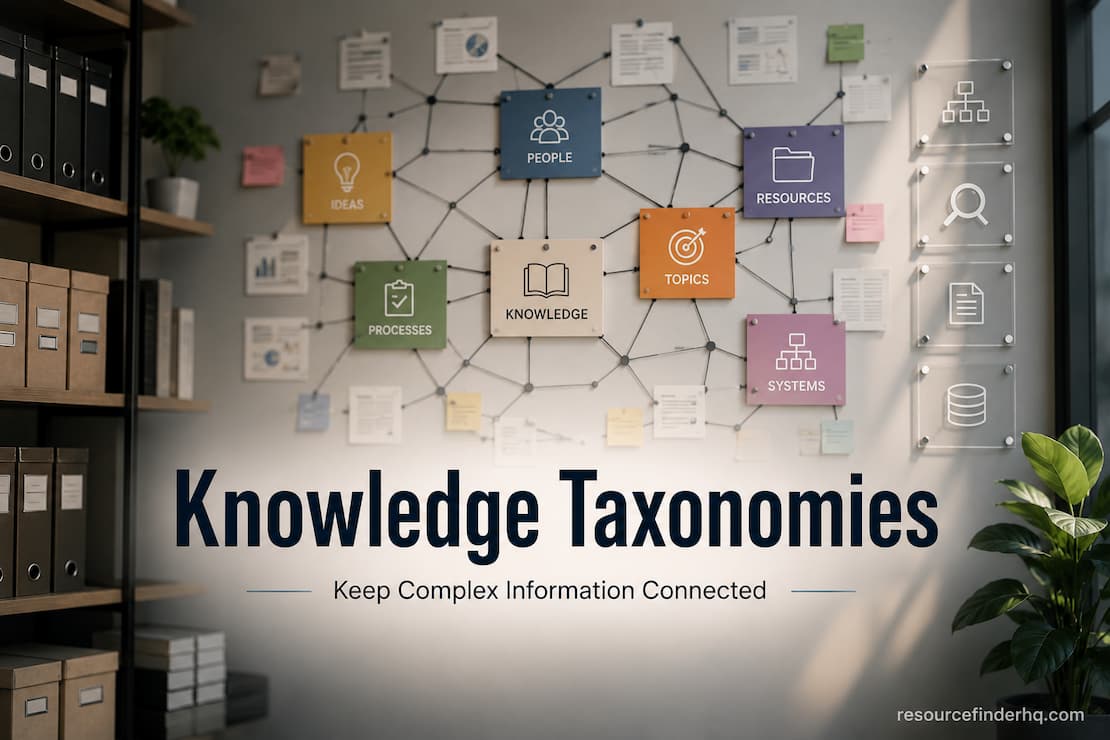
Growing information does not automatically increase knowledge. Over time, organizations acquire reports, manuals, research papers, meeting notes, customer records, design materials, and policy files. Users often struggle to understand how each resource relates to others, even though each is valuable. Finding one document is useful, but understanding where it belongs in a bigger body of knowledge helps people make judgments. That’s where knowledge taxonomies help.
Instead of storing data, a knowledge taxonomy organizes concepts. It asks how ideas relate across subjects, departments, and processes, not just where they belong. This method keeps knowledge useful even as collections become too huge to remember from experience.
Taxonomies Organize Ideas Instead of Locations
Classic folder architectures work best for information with one clear destination. Marketing materials may not belong in a legal folder, but contracts can. Real-world data rarely fits into one category throughout its existence. Review cybersecurity documents for cloud infrastructure. The content may interest security teams, network administrators, compliance professionals, software developers, and technical support staff. A taxonomy lets the document stay connected to related topics without duplicating content, while a folder forces one perspective.
This adaptability becomes more significant as firms use shared digital platforms instead of departmental storage. Information is no longer valuable because it’s permanent. It’s valuable because different perspectives can still uncover and understand it.
Related Ideas Strengthen Knowledge Networks
Information rarely stands alone. Database backup documentation naturally addresses disaster recovery, storage infrastructure, cybersecurity, compliance, and business continuity. These tools are effective alone, but knowing their relationships deepens comprehension.
Instead of treating every document as a destination, knowledge taxonomies organize concepts by meaning, fostering these relationships. Users following one topic can locate supplementary content that expands or enhances their learning, decreasing the need to seek related questions. This connected structure reduces duplication. Organizations can retain one authoritative document in various relevant taxonomy areas instead of developing multiple versions of the same information for different departments.
Knowledge Taxonomies Common Elements
Although taxonomies vary, many include relationships like the following:
- Broad topics.
- Specialized subjects.
- Related ideas.
- Parent-child categories.
- Cross-subject references.
- Business works.
- Industry lingo.
- Common synonyms.
These elements keep information connected rather than in separate collections.
Growing is Easier When the Structure can expand.
Many information systems start successfully because there are few documents. New products, services, technology, legislation, and corporate procedures create new information categories over time. Users experience overlapping themes, inconsistent terminology, and conflicting classification approaches without a flexible organizational structure.
Well-designed taxonomies predict growth. It permits new concepts to be added to the framework without rethinking it, keeping explicit links with existing themes.
Flexibility is especially useful in sectors with rapid knowledge changes. Cloud computing, digital security, healthcare technology, financial services, and scientific research provide new terms and behaviors. Organizations can maintain continuity as their knowledge base grows with an evolving taxonomy.
People Search Differently than expected.
Some people use different words to describe information. An experienced engineer may search using technical terms, whereas a fresh hire uses ordinary language. Compliance officers search by regulation, while customer support specialists use product names.
Instead of relying on exact wording, knowledge taxonomies connect related concepts to bridge these gaps. Synonyms, broad concepts, specific topics, and associated phrases help find content regardless of how someone searches.
This ability to accommodate multiple ideas becomes crucial as businesses grow. The taxonomy connects different ways of describing the same knowledge rather than asking users to grasp the same vocabulary.
Knowledge Taxonomies Enhance Non-Search Navigation
Search is the first step for obtaining digital material, but it’s not necessarily the greatest way to learn about new topics. Search works best when the searcher knows what they want. When trying to understand a whole issue or acquire new knowledge, it’s less successful.
Knowledge taxonomies solve these problems by routing users through related topics. For instance, cloud storage security research may include identity management, encryption, backup strategies, access restrictions, compliance frameworks, and disaster recovery. The taxonomy shows how various themes relate rather than showing isolated search results.
This navigation method is useful for learning environments and organizational knowledge bases. Users typically gain a deeper understanding by discovering material that keyword searches would have missed.
Consistent Terminology Reduces Organizational Chaos
Different departments often develop their own lexicon for similar concepts as businesses evolve. Some teams call them “clients,” others “customers,” and a third “accounts.” These terms may describe the same relationship, but inconsistent language can fragment data across systems.
A knowledge taxonomy standardizes definitions without forcing departments to change their language. Linking preferred terms to accepted alternatives lets users access the same information regardless of expression. The taxonomy relates organizational language through translation.
Collaboration improves with constancy. Because idea relationships have been specified, employees in different business functions spend less time understanding language and more time focused on information.
Digital Platforms Use Taxonomies Behind the Scenes
Many digital services use taxonomies without people knowing. Online learning platforms organize courses by related subjects, streaming services organize content by themes and genres, e-commerce websites categorize products, and enterprise knowledge bases structure policies, procedures, and technical documentation.
The value goes beyond browsing. Taxonomies help recommendation systems, content discovery, and intelligent navigation identify related resources. A platform often suggests another article, training module, or support document based on its knowledge structure relationships. These hidden links let people find essential information without specific search queries as collections grow.
Features of Effective Knowledge Taxonomies
Strong taxonomies have various traits.
- Clear categories have consistent meanings.
- Related ideas are logically related.
- Reduce duplicate or overlapping terms.
- Please add new subjects while maintaining the current arrangement.
- Relationships are clear across departments.
- Terminology reflects user search behavior.
A taxonomy succeeds when it expands naturally with the knowledge it reflects, rather than becoming harder to manage.
AI Benefits From Organized Knowledge
Well-organized data helps artificial intelligence summarize texts, recommend relevant topics, and answer complex inquiries. By showing how concepts link, knowledge taxonomies provide context instead of addressing each material separately.
When an AI-powered knowledge assistant recognizes that identity management, authentication, user accounts, and access control are closely related security domains, it may deliver more relevant responses. The taxonomy provides linkages to assist intelligent systems in perceiving data consistently.
Organizations benefit from explicit taxonomies even as AI advances. Structured knowledge strengthens intelligent tools for analysis, discovery, and recommendation and makes material easier to understand.
Connected Knowledge Improves Information
Different documents answer different questions, but significant relationships increase knowledge. Well-designed taxonomies arrange records into a network where concepts support, explain, and extend. Instead of searching or remembering, users can follow logical pathways to gain context and comprehension.
Taxonomies will remain a silent structure that connects digital knowledge across cloud platforms, enterprise systems, research environments, and educational materials. They help organizations maintain both their papers and the relationships that give them purpose, making complicated collections easier to manage and more useful for the future.
FAQs
1. Do knowledge taxonomies resemble folder structures?
No. Folders organize information storage, whereas a knowledge taxonomy organizes how ideas and concepts relate across the collection.
2. Can one document be in many taxonomies?
Yes. One resource can cover numerous topics without duplication. Different users can find the same information from different starting points.
3. Why do organizations invest in knowledge taxonomies?
They simplify navigation, terminology, information finding, collaboration, and maintenance of massive knowledge resources.
4. Should tiny businesses have a taxonomy?
Not always. Structures can be simplified for smaller collections. However, a taxonomy becomes more useful for preserving consistency and helping users grasp knowledge connections when teams, projects, and departments grow.