
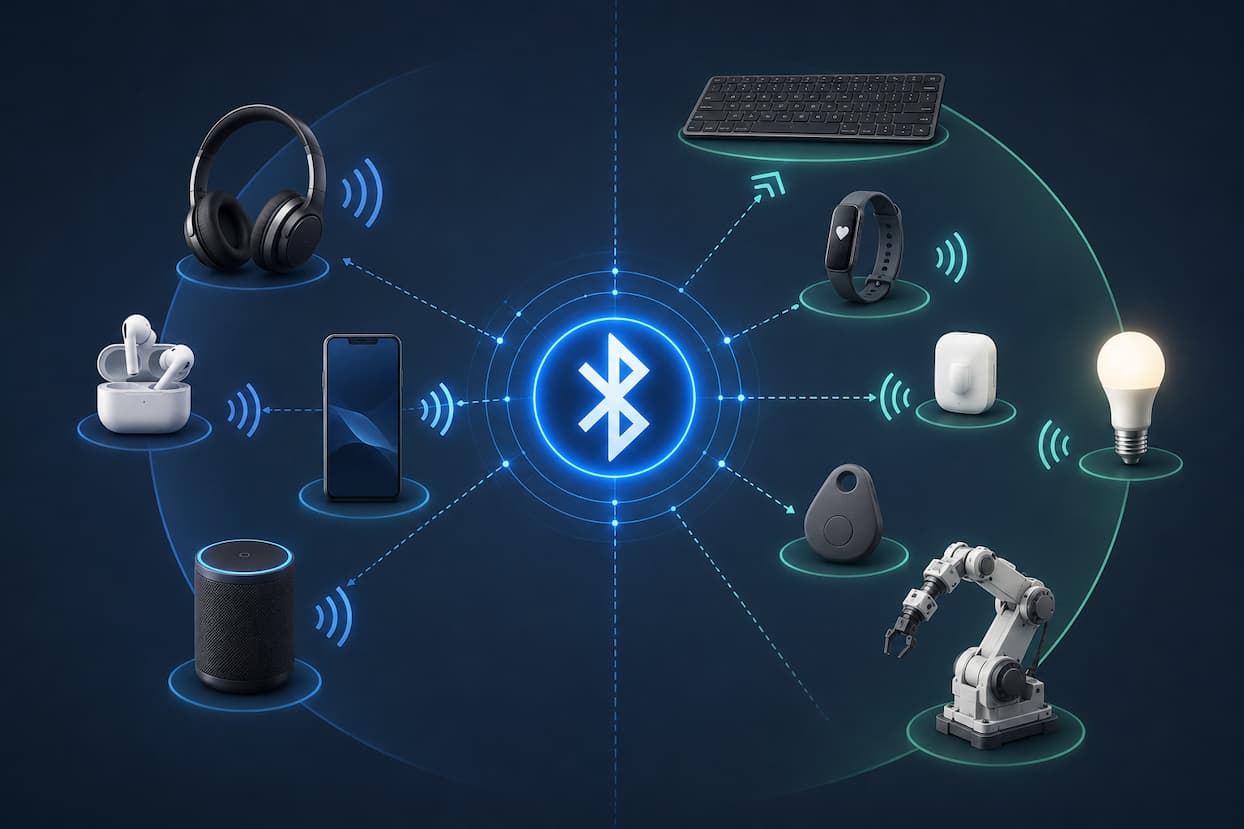
This development is due to the continuous improvement of the Bluetooth standard to meet diverse technical needs. Some applications require continuous, high-quality data transfer, while others only need to transmit minimal data and consume almost no power. Early versions of Bluetooth required direct connections, while newer versions can communicate with multiple devices and even help locate signal sources.
Viewing it from a broader perspective makes Bluetooth easier to understand. It also explains why two devices with Bluetooth functionality can function very differently. This guide offers an in-depth look at the history of Bluetooth, the differences between Bluetooth Classic and Bluetooth Low Energy, the features of the latest updates, and the characteristics to consider when purchasing Bluetooth devices.
The Truth About Bluetooth
Bluetooth technology enables electronic devices to communicate wirelessly over short distances without physical cables. It shares the same radio spectrum, the 2.4 GHz band, with other wireless technologies such as Wi-Fi. The Bluetooth Special Interest Group (SIG) is responsible for maintaining the Bluetooth standard. The SIG develops the relevant standards to facilitate the development of products that can communicate within the Bluetooth ecosystem.
Contrary to popular belief, Bluetooth is not a standalone feature. Rather, it is a collection of standards and technologies used to enable various forms of communication. Temperature sensors, smart locks, Bluetooth mice, and headphones all use the same technology, making differentiation crucial. Their power strategies, communication technologies, Bluetooth profiles, and functionalities can differ.
The Development History of Bluetooth Audio Applications
The rise of smartphones, wireless headphones, and computer accessories has accelerated the spread of Bluetooth technology. These groundbreaking applications proved that eliminating cables for short-distance connections was a viable solution. As manufacturers and programmers embraced the technology, new applications emerged. Bluetooth technology has developed rapidly and has a wide range of applications, including: connecting input devices, communicating with sensors, controlling devices, and exchanging small amounts of data between phones and accessories.
The introduction of Bluetooth Low Energy (BLE) has significantly accelerated this development. As a result, Bluetooth technology is better suited for products that require connection with small batteries. Bluetooth technology has also evolved further and no longer focuses solely on continuous data streaming, such as music, but now also supports devices that can wake up, exchange small amounts of data, and then return to a power-saving mode. This enables a greater variety of connected devices.
Bluetooth Classic and Bluetooth Low Energy
One of the most important concepts for beginners is that Bluetooth Classic and Bluetooth Low Energy, often called Bluetooth LE or BLE, are designed with different priorities.
| Feature | Bluetooth Classic | Bluetooth Low Energy |
|---|---|---|
| Main focus | Continuous or relatively higher-throughput connections | Efficient communication with low energy use |
| Common examples | Traditional wireless audio and some computer accessories | Sensors, trackers, wearables, smart devices |
| Power strategy | Generally suited to devices with greater energy availability | Designed for efficient battery-powered operation |
| Typical communication | Can maintain ongoing data connections | Often exchanges smaller amounts of data efficiently |
The distinction does not mean one is newer and the other is simply obsolete. They serve different purposes. A device may support one or both technologies depending on what it needs to do. This is why checking only the words “Bluetooth compatible” is not always enough when buying a product. The exact Bluetooth capabilities supported by the device can matter considerably.
Why Bluetooth Profiles Matter
The fundamental technology is defined by Bluetooth specifications, whereas profiles detail how Bluetooth performs for certain jobs. In order to ensure that devices that are compatible with each other communicate in the expected manner, profiles offer rules for specific types of applications. There are a variety of communication protocols used by various devices; for instance, audio products may have profiles tailored to wireless audio communications. Bluetooth Low Energy (LE) services enable health and fitness devices to share sensor data with compatible apps.
Just because two gadgets have Bluetooth doesn’t mean they will necessarily function together. The features and implementation of each device’s support determine the level of compatibility. Do not rely solely on the word “Bluetooth” when determining compatibility; instead, search for the specific Bluetooth features, profiles, or services that are supported by both products. Bluetooth is an ecosystem, not a universal plug-and-play promise; this may sound confusing to regular consumers, but the practical lesson is simple.
The Role of Bluetooth in Enabling Low-Power Devices
Miniature devices’ battery lives are of paramount importance. Having to plug in a wireless sensor every few days might be a pain, particularly if it’s in an awkward spot. To overcome this obstacle, Bluetooth Low Energy facilitates effective device communication. A sensor can often operate in a low-power mode and only transmit data when absolutely necessary.
Think of a basic thermometer. At regular intervals, it could take environmental readings, transmit those results to a nearby device, and then go back into a power-saving mode. Unlike a wireless speaker, it can function normally even when not connected to a constant, high-bandwidth network. This method has made Bluetooth more practical for devices that prioritize power saving over constant data transfer.
Bluetooth Low Energy’s Expansion
The introduction of Bluetooth Low Energy was a key component in Bluetooth’s evolution from an accessory-centric technology to a platform for interconnected devices. Small sensors, health-related gadgets, smart controls, location tags, and wearable items are just a few of the numerous uses for BLE. The communication model of Bluetooth Low Energy shines for low-volume data exchanges that don’t require a constant high-power connection.
The utilization of services and attributes is a crucial component of BLE. These provide devices standardized methods of describing and exchanging data. A compatible application that follows the applicable specifications can read or interact with a device’s exposed data. Because of its design, BLE is very adaptable. Instead of seeing every Bluetooth device as a mere audio attachment, developers may now construct products based on certain types of data.
Multiple-Device Networks with Bluetooth Mesh
When most people think of Bluetooth, they probably picture a single phone talking to a single item. By enabling many-to-many communication under appropriate network settings, Bluetooth Mesh broadened the notion. When many devices in a larger area need to connect with each other, mesh networking is often the best option. All devices don’t need to be directly connected to a controller; instead, messages can be routed through a network of nodes.
Use cases where there are many interconnected devices include building automation, lighting control, and similar setups. Although not suitable for all smart-home configurations, Bluetooth Mesh showcases the significant advancements made by Bluetooth beyond its initial point-to-point accessory connection capabilities.
Location Services and Bluetooth
Devices can learn to recognize one other’s proximity using Bluetooth, and newer versions of the technology even allow for more sophisticated location-based apps. Nearby devices can pick up identifiers broadcast by Bluetooth Low Energy beacons and related technologies. Applications like asset awareness, proximity-based experiences, and indoor information systems can all benefit from this.
Compared to older proximity approaches, newer Bluetooth capabilities also support more accurate direction and distance-related applications. The use of Bluetooth for object detection, indoor navigation, access control, and location-aware systems has grown in popularity due to these advancements. Nevertheless, Bluetooth cannot replace all positioning technologies. The environment, implementation, hardware, and Bluetooth characteristics in question all have an impact on the accuracy.
Wireless Connections in Smart Homes and Commonplace Items
The use of Bluetooth in consumer and smart home goods is on the rise. It has multiple uses, including device configuration, local control, sensor connectivity, and mobile app engagement. A smart gadget, for instance, might pair with another network technology for normal operation after initial setup using Bluetooth. Since other goods may only require sharing very modest amounts of data when in close proximity, Bluetooth could be their principal means of communication.
For devices that require immediate local engagement, Bluetooth is also a highly effective choice. A smartphone can have a conversation with a nearby device without having to use the internet for every single transaction. For reasons of responsiveness, privacy, and situations where access to the internet is not available, this local capability can be quite helpful. The product and its software determine the actual behavior, though.
A Lot of Changes Are Ahead for Bluetooth Audio
Despite Bluetooth’s extensive feature set, wireless sound is still a key use case. Even in this domain, technological advancements have persisted. Bluetooth LE Audio unveiled a novel method of wireless audio transmission based on Bluetooth Low Energy. Its purpose is to facilitate enhanced performance and the introduction of new features, such as those pertaining to broadcast audio.
With broadcast audio, a single source can transmit audio to numerous suitable receivers. Public areas, collaborative listening experiences, accessible apps, and individual audio usage are all opened up by this. The key takeaway is that Bluetooth has not compromised on its core competencies to accommodate its growth. On the contrary, advancements in the technology have persisted in various contexts, including those that do not involve music.
What Makes Bluetooth Compatibility Difficult
The concept of Bluetooth compatibility is frequently distorted. There may be restrictions when using a phone and accessory that both support Bluetooth. One explanation is that there might be discrepancies across Bluetooth profiles, versions, codecs, services, and optional features. You might discover that a newer phone has a feature that an older accessory doesn’t. Just as two devices might link up without a hitch, they also cannot have all the features a consumer would like.
Software changes might also affect compatibility. On occasion, manufacturers enhance support by releasing updated firmware or operating systems. Think about what you need before you buy a Bluetooth device. Verify the audio and codec support if you desire wireless audio. If you want a sensor, make sure to check the required BLE services. Always verify the device’s platform and app compatibility before purchasing a tracker or smart home gadget.
Common Errors Regarding Bluetooth
Many people mistakenly believe that all Bluetooth devices offer the same range. Device design, transmission power, antenna performance, impediments, and Bluetooth technologies all play a role in determining range. A further misconception is that all devices become faster when the Bluetooth version is upgraded. The real advantages, if any, from updated standards are conditional on the capabilities of the two linked devices.
Another common misconception is that Bluetooth always needs an active internet connection. Absolutely not. Some Bluetooth devices rely on internet connectivity for remote control or cloud services, but others can communicate locally even without an internet connection. Last but not least, not every wireless application is ideal for Bluetooth. Different wireless technologies may excel at different things; Wi-Fi could be great for data with a large bandwidth, but other options could be better for distant communication or niche uses.
How to Use Bluetooth Devices in a Real World Setting
First, make sure you know what each item can do. The Bluetooth version number is not the only thing that matters. When applicable, check the operating system requirements, supporting profiles, services, and codecs. When first setting up your devices, it’s best to keep them near together as you pair and use them. Physical barriers and interference can impact performance.
Always use the most recent firmware and operating system updates provided by reputable manufacturers. Updates can enhance stability, compatibility, and security. Prioritize the fundamentals while attempting troubleshooting. Before you start pairing, check that Bluetooth is on, ensure the devices are compatible, delete any previous pairings, and then restart them. If you still can’t find the solution, look up your specific product model in the manual.
| Problem | Possible Cause | Practical Step |
|---|---|---|
| The device will not pair | Compatibility or previous pairing issue | Check supported features and remove the old pairing |
| Connection drops | Distance, obstacles, or interference | Move devices closer and test in another location |
| The feature is unavailable | Devices support different capabilities | Check profiles, services, and software requirements |
| The battery drains quickly | Usage pattern or device settings | Review connection behaviour and power settings |
| The device is not detected | Pairing mode or software problem | Restart devices and follow the manufacturer’s pairing procedure |
Conclusion
Bluetooth has long since transcended its original role as a technology for wireless headphones and speakers. The evolution of Bluetooth technology has created a vast ecosystem that supports audio, energy-efficient sensors, wearables, smart home devices, location services, computer accessories, and networks with countless interconnected devices.
The development of Bluetooth Low Energy (BLE) is particularly important because it enables efficient wireless communication, even in small battery-powered products. Other technological advancements, such as mesh networks, location services, and improved audio technologies, continue to expand the applications of Bluetooth.
For the average user, it is important to know that Bluetooth is not a technology with just one function. Different devices support different functions, profiles, and communication methods. Understanding these differences helps you choose compatible products.
FAQs
1. Is Bluetooth only for wireless headphones?
No. Wireless audio is one of the most common applications of Bluetooth, but it is also used in keyboards, mice, sensors, wearables, trackers, smart home products, medical devices, access control systems, and many other devices. Bluetooth Low Energy (BLE) plays a particularly important role in extending this technology to products that need to exchange small amounts of data and conserve battery power.
2. What is the difference between Bluetooth Classic and Bluetooth Low Energy?
Bluetooth Classic is typically used for applications that require continuous communication, including many traditional wireless audio connections. Bluetooth Low Energy is designed with energy efficiency as a core principle and is widely used in sensors, trackers, wearables, and other battery-powered devices. Both are part of the Bluetooth ecosystem, but with different design focus points.
3. Does a newer version of Bluetooth guarantee better performance?
Not necessarily. Newer versions of Bluetooth can introduce new features and improvements, but you will only benefit from them if both devices support the relevant features. Performance also depends on hardware, software, distance, interference, and the specific application. Therefore, when comparing products, it is not sufficient to look only at the Bluetooth version.
4. Can Bluetooth work without Wi-Fi or a mobile network?
Yes. Bluetooth is a local wireless communication technology that does not require an internet connection. Phones can connect directly to keyboards, speakers, sensors, or other compatible devices without internet access. However, some products use Bluetooth for local communication, while relying on Wi-Fi or mobile data for access to cloud services and remote functions.
5. Why can two Bluetooth devices connect but not work properly?
Bluetooth compatibility is not just about the presence of Bluetooth hardware. Devices can support different profiles, services, codecs, or optional features. Two products may establish a basic connection but not offer support for specific functions. For specialized devices and advanced features, it is especially important to check the manufacturer’s compatibility information.
6. Is Bluetooth safe?
Bluetooth contains security mechanisms, but security depends on the version, implementation, device configuration, and how the technology is used. Users must keep their operating system and device firmware up to date and avoid connecting to unknown devices. For sensitive applications, organizations must follow appropriate security guidelines rather than assuming that wireless communication is automatically secure.
References
- Bluetooth Special Interest Group (Bluetooth SIG) — Official Bluetooth technology specifications, profiles, and feature information.
- Bluetooth SIG — Bluetooth Low Energy and Bluetooth Mesh technical resources.
- Bluetooth SIG — LE Audio and Auracast broadcast audio information.
- National Institute of Standards and Technology (NIST) — Guidance and publications concerning wireless technology and security.
- European Telecommunications Standards Institute (ETSI) — Standards and technical information relating to radio and wireless communication technologies.