
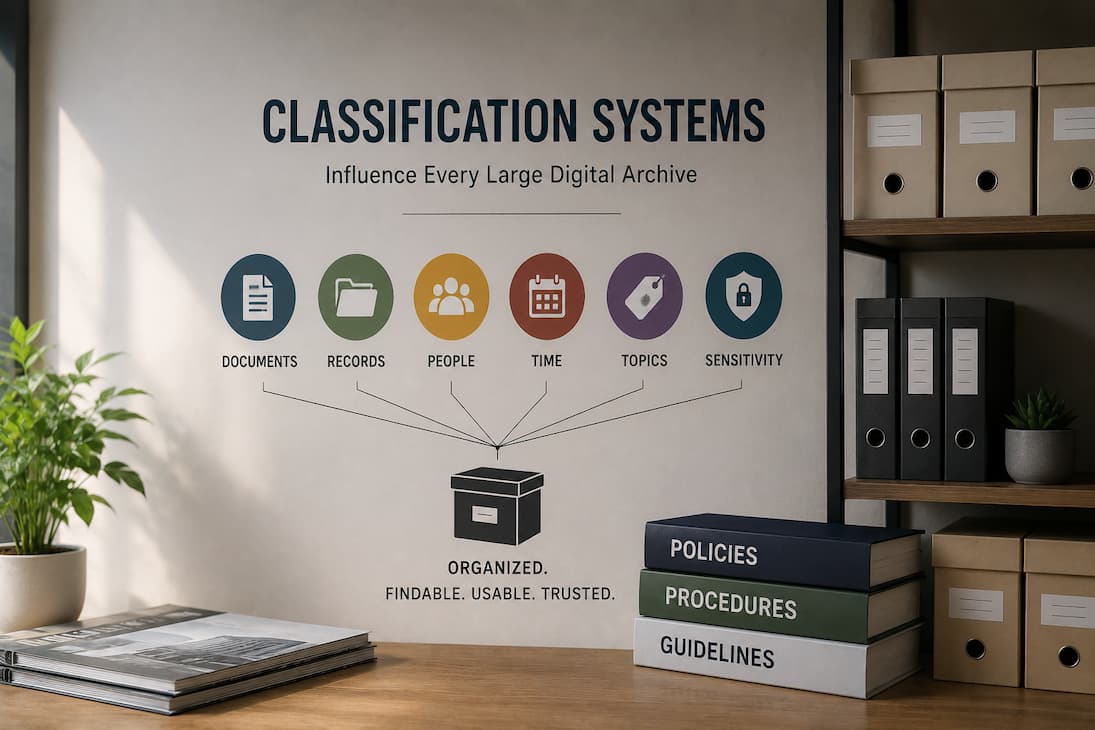
Searching through an old photo collection or a folder full of years of documents has shown the difference between storing and organizing information. When the collection is millions or billions of files, the issue gets even larger. Find important information without remembering filenames or browsing folders at that scale. Long before anyone searches for it, digital archives need systems that reliably classify, group, and identify material.
Classifications provide structure. Instead of tracking where information is stored, they categorize it by shared qualities. This method keeps archives manageable as they grow since retrieval relies on logic rather than location. Classification makes an enormous archive of historical photos, engineering documents, scientific research, financial records, or customer correspondence usable by humans and software.
Classification Is For Use, Not Storage
Folders and classification both organize information; therefore, people confuse them. Though they collaborate, they solve separate issues. A folder tells the system where an item resides, while classification defines it. A corporation maintains contracts, invoices, personnel policies, and product manuals in the cloud. These files may be in separate directories, but classification offers another layer of knowledge by identifying each document by function. An invoice remains an invoice even after you move it to another folder. An archived legal agreement does not cease to be a contract after a project ends.
This distinction becomes more important as firms use cloud platforms and exchange, copy, and synchronize data across systems. Consistent categorization keeps information recognizable even if storage sites shift.
Well-Designed Categories Reduce Future Complexity
Creating a classification system rarely involves choosing the most categories. Often, the opposite is true. Classifying information clearly helps people see key differences without overwhelming them with complexity.
Suppose a digital archive holds hundreds of product technical documents. If every paper were labeled “Manual,” finding precise information would be difficult. By adding hundreds of highly specialized categories, the system could become confusing and inconsistent. The most effective technique combines broad organizational categories with sufficient detail to distinguish information for different uses. Early classification decisions become more important as archives grow. Structures that work for a few thousand documents are more likely to be beneficial as the collection grows to millions.
Common Digital Archive Classifications
Large archives categorize information like the following:
- Administrative files.
- Financial records.
- Technical info.
- Legal agreements.
- Client communications.
- Research tools.
- Marketing materials.
- How things work.
- Past records.
While organizations’ categories vary, the goal is to simplify information management throughout its lifecycle.
Classification goes Beyond Search
Finding information is one of the most obvious benefits of classification, but there are others. Categories provide retention policies, access restrictions, automation, compliance, reporting, and long-term preservation on modern digital systems.
Because each category has its own organizational policy, a records management system may automatically keep tax documents longer than internal meeting notes. Similarly, sensitive legal papers may have stronger access restrictions than public training materials. The classification method allows software to reliably discriminate between types of information, making these decisions realistic. Without consistent classification, many automated procedures would require manual review, limiting efficiency and risking inconsistent decisions across vast collections.
Digital Archives Evolve
No classification is perfect permanently. Organizations create new products, technologies, industries, and information since the archive was designed. These changes require the classification framework to update with the collection.
Classification updates require careful consideration because they influence more than labels. Organizational structures may affect search tools, reporting systems, retention policies, access controls, and automation workflows. A badly conceived modification can confuse, even if the goal is to improve the archive. Many companies reassess their classification strategies occasionally rather than permanently. An effective archive requires constant organizational framework adaptation while maintaining enough consistency to locate and handle existing material.
Info-classification Helps Maintain Consistency
As digital archives grow, treating every record the same becomes impractical. A temporary project draft should not be kept as long as audited financial documents, and a customer support interaction should not be treated like a signed legal agreement. Classifying information helps businesses to apply distinct management rules based on its role.
A document’s classification in a digital repository might automatically affect several procedures. It may determine how long the data is kept, which departments can access it, whether changes require approval, and whether the record should be archived. The classification system automates management instead of requiring staff to make these selections frequently. This method is extremely useful when thousands of records are created daily. Good classification policies let software apply organizational standards across the archive, making consistency easier than manual decisions.
A Record Can Be Classified Multiple Times
Many people think classification means labeling every file, but newer archives are more flexible. Information sometimes belongs to numerous categories because it serves multiple objectives in an organization. A project proposal may be a business document, affiliated with a client, linked to a regional office, secret, and part of an ongoing initiative. Instead of competing, each classification describes a different trait.
A layered approach gives users more ways to locate and manage information. Someone looking by department, another by project, and a compliance officer checking confidential documents may see the same document categorized differently. Because users can interpret content from multiple angles, they find the archive easier to traverse.
Common Classification Approaches
Digital archives often organize records using more than one classification method.
| Classification Method | Typical Use |
|---|---|
| By document type | Distinguishes reports, invoices, manuals, and contracts. |
| By department | Groups information according to business functions. |
| By project | Connects records created for the same initiative. |
| By subject | Organizes content around common topics or themes. |
| By sensitivity | Identifies public, internal, confidential, or restricted information. |
| By lifecycle stage | Separates drafts, active records, archived materials, and historical content. |
Combining these approaches provides greater flexibility than relying on a single organizational structure.
Classification Makes Large Archives Easier to Analyze
Classification is useful beyond finding records. It also helps organizations identify data patterns. Consistent record classification improves reports, dashboards, and analytics.
An organization may wish to know how many technical manuals were updated last year or how quickly customer support documentation has expanded over the past five years. Answering these questions may entail evaluating thousands of data without classification. With uniform categories, reporting systems may summarize data more efficiently. Analysis of collections rather than individual papers improves planning, resource allocation, and long-term decision-making. Thus, classification helps organize and understand information change.
Classification Needs Clear Standards
Successful archives have various traits.
- Categories have definite meanings.
- Similar records are categorized similarly.
- New information follows rules.
- Outdated categories are evaluated periodically.
- Staff know how to classify records.
- Automation enhances careful organization.
These practices prevent archives from becoming inconsistent as collections grow.
AI Helps Classification
AI is increasingly recommending categories for fresh data. Intelligent algorithms can assess document content, predict potential subjects, recognize business lingo, and suggest archive locations instead of requiring workers to manually designate categories.
However, AI works best when it builds on a classification foundation. Clear organizational rules give intelligent systems reference points for more accurate recommendations. If categories overlap or lack consistent definitions, automatic categorization loses reliability due to a lack of structure. Thus, many organizations utilize AI to support information governance rather than replace it. While automation speeds up routine classification, human monitoring keeps complicated or sensitive records structured.
Classification Makes Digital Archives Useful
Large digital archives organize material in meaningful ways that last. Classification defines information, how to manage it, who may access it, and how it links to other records throughout its existence.
As businesses generate more digital content, successful classification will remain a silent system supporting reliable search, consistent governance, accurate reporting, and long-term preservation. User focus may be on the documents, but the classification system often decides whether they are practical, discoverable, and valuable years later.
FAQs
1. Does classification mean tagging?
Not exactly. Although classification follows a hierarchical organizational framework with established categories, tags are more flexible and may provide extra qualities that help search and filtering.
2. Organizations review classification systems. Why?
Business operations, rules, and technology change. Periodic assessments ensure categories represent current information rather than old organizational structures.
3. Can one document be in numerous categories?
Yes. Many digital archives classify records by document type, department, project, and security level.
4. Is classification better for search?
By providing context for organizing, filtering, and ranking relevant material, classification enhances search quality without replacing search indexes.