
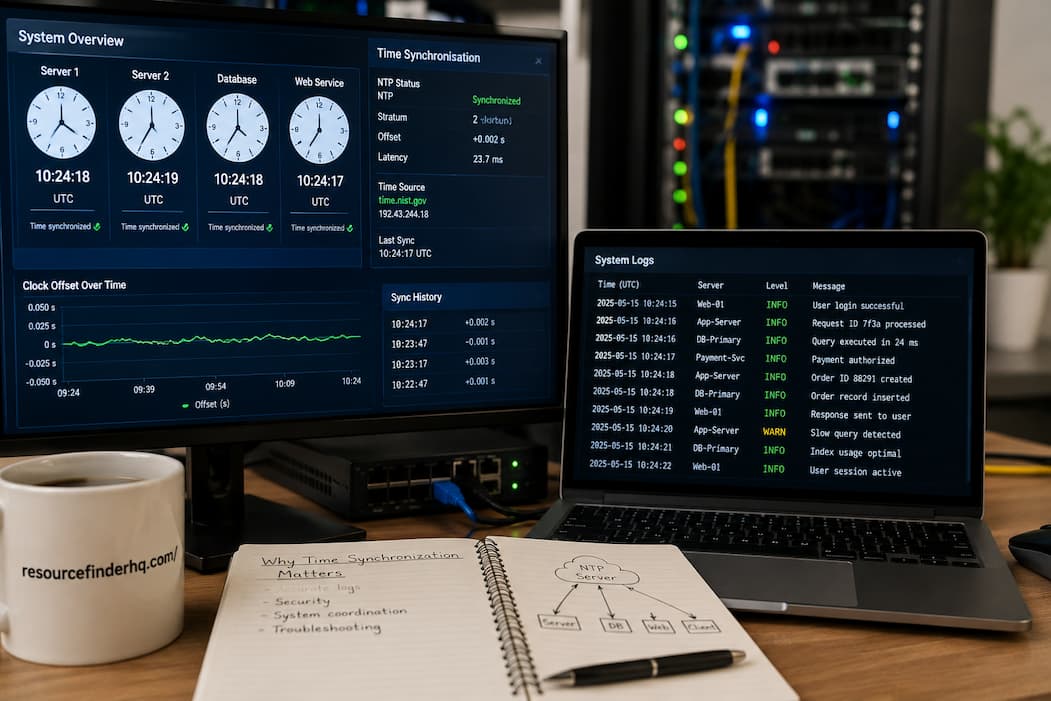
Modern digital systems rarely operate from a single computer. A typical service may have application servers in several locations, databases running on separate machines, cloud infrastructure spread across regions, employee devices connecting from different networks, and security systems recording activity independently.
All of those components need some understanding of when things happen.
That is where time synchronization becomes important. Computers do not automatically share a perfectly accurate clock. Each device maintains its system clock, and that clock can gradually drift away from the correct time. Even a relatively small difference can make records harder to interpret when many machines are working together.
Time synchronization provides a way for computers and networked systems to regularly adjust their clocks against trusted time references. Protocols such as the Network Time Protocol (NTP) help devices keep their clocks sufficiently aligned for many everyday computing tasks.
The goal is not necessarily to make every computer display the same fraction of a second. The real objective is to give distributed systems a consistent timeline they can use for communication, logging, security, coordination, and troubleshooting.
Why Computers Cannot Simply Keep Perfect Time
Hardware and software maintain a computer’s clock, but it is not perfectly stable. The oscillator used to measure time can run slightly faster or slower than the ideal rate.
That difference is called clock drift.
Imagine two servers that are synchronized at exactly 12:00:00. If one clock runs slightly faster and the other slightly slower, their readings will gradually diverge. Eventually, the two systems may disagree about when an event occurred.
This becomes a practical problem when applications depend on timestamps.
A log entry from one server might say an event happened at 10:15:04, while another server records a related event at 10:15:02. Without synchronized clocks, an administrator could incorrectly conclude that the second event happened first.
Time synchronization reduces this uncertainty by periodically comparing system clocks with reliable time sources.
What Time Synchronization Actually Does
Time synchronization allows a computer to compare its local clock with a reference clock and make an adjustment when necessary.
NTP is one of the most widely used protocols for this purpose. It was designed to synchronize computer clocks across packet-switched networks and can account for network communication delays when estimating the difference between clocks.
A simplified process looks like this:
Local clock → time request → time source → response → clock comparison → adjustment
The computer does not simply assume that the time shown by a remote server is the exact moment the message arrives. Network packets take time to travel, and that delay can vary.
Instead, time-synchronization software uses measurements from communication between the systems to estimate the appropriate correction.
For many systems, this process happens automatically in the background.
Why Accurate Time Matters in Distributed Systems
The importance of synchronized clocks becomes much clearer when several systems participate in the same operation.
Suppose an online application uses one server to receive a request, another server to process it, and a database on a third system to store the result. Each component may create its own records.
If their clocks are significantly different, reconstructing the sequence of events becomes difficult.
A synchronized timeline helps developers and administrators answer questions such as:
- When did the request arrive?
- Which server processed it first?
- When did the database record change?
- When did an error occur?
- How long did the operation take?
- Which event happened immediately before the failure?
The timestamps do not solve every distributed-systems problem, but they provide a common temporal reference that makes the system easier to understand.
Logs Become Much More Useful
System logs are one of the most obvious places where time synchronization matters.
A production environment can generate thousands or millions of log entries from different machines. When something goes wrong, an administrator may need to combine records from application servers, databases, firewalls, load balancers, operating systems, and other components.
If those systems have inconsistent clocks, the resulting timeline can become misleading.
For example, imagine three records:
- Server A: request received at 14:20:10
- Server B: database query started at 14:20:08
- Server C: error recorded at 14:20:12
At first glance, the database query appears to happen before the request was received. That may be impossible in the actual application flow. The problem could simply be that Server B’s clock is several seconds behind.
Synchronizing the clocks does not guarantee that every timestamp is perfectly identical, but it makes cross-system investigation much more reliable.
Security Systems Depend on Reliable Time
Time also plays an important role in security.
Security systems generate timestamps for authentication attempts, access events, configuration changes, alerts, and other activities. When an organization investigates suspicious activity, it may need to establish a sequence of events across multiple systems.
A reliable timeline can help investigators determine whether an authentication attempt occurred before an account change, whether a security alert preceded a configuration modification, or whether activity occurred within a particular period.
Some security technologies also use time as part of their operation. Authentication mechanisms can use timestamps to limit how long certain credentials or authentication messages remain valid.
If system clocks are substantially incorrect, legitimate authentication can fail or security mechanisms can behave unexpectedly.
This is one reason reliable time synchronization is treated as an infrastructure concern rather than merely a convenience for displaying the correct clock.
Time Synchronization and Databases
Databases can also benefit from consistent system time, particularly when multiple services interact with the same data. Applications frequently attach timestamps to records such as orders, messages, status changes, audit events, and updates. When different servers generate those timestamps, clock differences can complicate interpretation.
However, synchronized clocks do not automatically solve every ordering problem in distributed databases.
Two events can occur so close together that their timestamps do not establish a definitive causal relationship. Network delays, concurrent operations, transaction processing, and database consistency mechanisms can introduce additional complexity.
For that reason, distributed systems may use mechanisms beyond ordinary wall-clock synchronization when they need to establish event ordering. Logical clocks, sequence numbers, transaction identifiers, and other techniques can provide information that physical time alone cannot.
NTP Is Not the Only Time-Synchronization Technology
NTP is widely used, but it is not the only approach.
Precision Time Protocol (PTP) is designed for environments where much more precise synchronization is required. It is commonly associated with specialized applications such as industrial automation, telecommunications, measurement systems, and other environments where very small timing differences matter.
Some systems also obtain time from specialized hardware sources or highly accurate reference clocks.
The appropriate solution depends on the required precision.
A typical office computer does not need the same timing infrastructure as a system coordinating high-speed industrial equipment. Using a more sophisticated synchronization method than the application requires can add unnecessary complexity.
What Happens When Clocks Are Not Synchronized?
Poor time synchronization can produce problems that are surprisingly difficult to diagnose.
One common symptom is confusing log order. Events that should appear sequentially may seem to occur in the wrong order.
Another problem involves certificates, authentication systems, and time-sensitive credentials. If a device believes that the current date or time is significantly different from the expected value, systems that depend on validity periods can reject otherwise legitimate operations.
Scheduled tasks can also be affected. A clock that jumps forward or backward may cause scheduled operations to behave differently from what an administrator expects.
Monitoring systems can experience difficulties as well. Metrics and alerts depend heavily on timestamps, so inconsistent clocks can make it harder to correlate measurements from different machines.
Synchronization Does Not Mean Every Clock Is Identical
A useful distinction is that synchronized does not necessarily mean identical.
Network conditions introduce delays and uncertainty. Different synchronization technologies have different levels of precision, and operating systems may adjust their clocks gradually rather than making abrupt changes.
For many applications, being within an acceptable range of the reference time is sufficient.
The required accuracy depends on the system.
An ordinary business application may function perfectly well when participating machines are synchronized within a relatively modest tolerance. A scientific measurement system or specialized industrial environment may require substantially tighter synchronization.
The correct question is therefore not simply, “Are the clocks synchronized?”
It is:
“Are the clocks synchronized accurately enough for what this system needs to do?”
UTC Provides a Common Reference
Distributed systems also need a common understanding of what a timestamp represents.
Coordinating systems across different geographic locations becomes easier when they use a standardized reference such as Coordinated Universal Time (UTC).
A server in one country and another server on the opposite side of the world can record events using UTC without having to interpret local daylight-saving changes or regional clock settings.
Applications can then convert UTC timestamps into a user’s local time when displaying information.
This separation between a standardized stored time and a locally displayed time is especially useful for global services.
Time Zones Are a Different Problem
Time synchronization and time-zone management are related but distinct issues. Synchronization concerns whether a computer’s clock represents the correct moment. A time zone concerns how that moment is represented for a particular geographic or regional context.
For example, two servers can both have correctly synchronized clocks while displaying different local times because they are configured for different time zones.
This distinction becomes important when developing applications that store timestamps, schedule events, or serve users across multiple countries. A system can have accurate clocks and still display an event incorrectly if its time-zone handling is poorly designed.
How Organizations Can Improve Time Reliability
Maintaining reliable system time is usually an infrastructure task rather than something individual users need to manage manually.
Organizations should establish consistent time-synchronization practices across servers, network devices, workstations, applications, and other systems where timestamps matter.
A practical approach includes using reliable time sources, configuring systems to synchronize automatically, monitoring synchronization status, and investigating devices that repeatedly lose synchronization.
Administrators should also avoid treating one manually configured clock as the permanent solution. A clock that is correct today can drift tomorrow.
Redundancy is useful as well. Depending on the environment, systems can be configured to use multiple trusted time sources rather than relying on a single source that could become unavailable.
How Developers Should Handle Timestamps
Developers should also think carefully about how applications represent time.
A timestamp should communicate enough information to identify the intended moment. Storing ambiguous local times can create problems when systems operate across regions or daylight-saving changes.
For many applications, storing timestamps in UTC and converting them for presentation is a practical design approach. However, applications dealing with future appointments or recurring local events may also need explicit time-zone information because “9:00 AM every Monday” represents a local scheduling rule rather than merely a fixed UTC instant.
The distinction between an instant in time and a local calendar time is easy to overlook and can cause subtle bugs.
A Simple Example of Why Synchronization Matters
Consider an online shopping platform with four components: a web server, an application server, a payment service, and a database.
A customer places an order at 16:30:00. The web server records the request, the application server creates the order, the payment service processes the payment, and the database records the final status.
- If all four systems have reasonably synchronized clocks, an administrator can inspect their logs and reconstruct the transaction.
- If one server’s clock is several minutes behind, the payment might appear to have been processed before the order was created.
- The system may still have completed the transaction correctly. The problem is that its records no longer tell the story clearly.
- This example illustrates why time synchronization is valuable even when users never notice the clocks themselves.
Conclusion
Time synchronization is often neglected because users do not see the infrastructure that supports it. Yet distributed digital systems depend on reliable timing to turn thousands of individual events into a timeline that people and software can understand.
Synchronized clocks help administrators correlate logs, investigate incidents, interpret transactions, monitor applications, and operate services across multiple machines. They also support systems that depend on time-sensitive authentication and scheduled operations.
The key is to match synchronization practices to the system’s actual requirements. General-purpose applications may need reliable NTP-based synchronization, while specialized environments may require significantly greater precision. Just as importantly, developers and administrators need to distinguish clock synchronization from time-zone handling and understand that accurate physical time does not solve every distributed-ordering problem.
When machines share a dependable reference for time, the individual components of a distributed system have a much better chance of telling the same story about what happened and when.
Frequently Asked Questions
What is time synchronization?
Time synchronization is the process of keeping computer and network-device clocks aligned with a trusted time reference. It helps distributed systems maintain consistent timestamps and reliable timing information.
Why is time synchronization important for servers?
Servers often communicate with other servers and generate logs, authentication records, database entries, and monitoring data. Synchronized clocks make it easier to correlate these events and understand their order.
What is NTP?
NTP, or Network Time Protocol, is a protocol used to synchronize computer clocks over networks. It allows systems to compare their local time with reference time sources and make appropriate clock adjustments.
Does time synchronization make all computers show exactly the same time?
Not necessarily. Network delays, clock characteristics, operating-system behavior, and the synchronization method can introduce small differences. The important question is whether the remaining difference is within the tolerance required by the application.
What happens if servers have different times?
Significant clock differences can make logs difficult to correlate, interfere with time-sensitive authentication, complicate monitoring, and make troubleshooting distributed applications more difficult.
Can synchronized clocks determine the exact order of every event?
No. Physical timestamps alone cannot always establish causality in a distributed system, especially when events occur very close together. Distributed applications may use additional mechanisms such as sequence numbers or logical clocks when precise event ordering is required.