
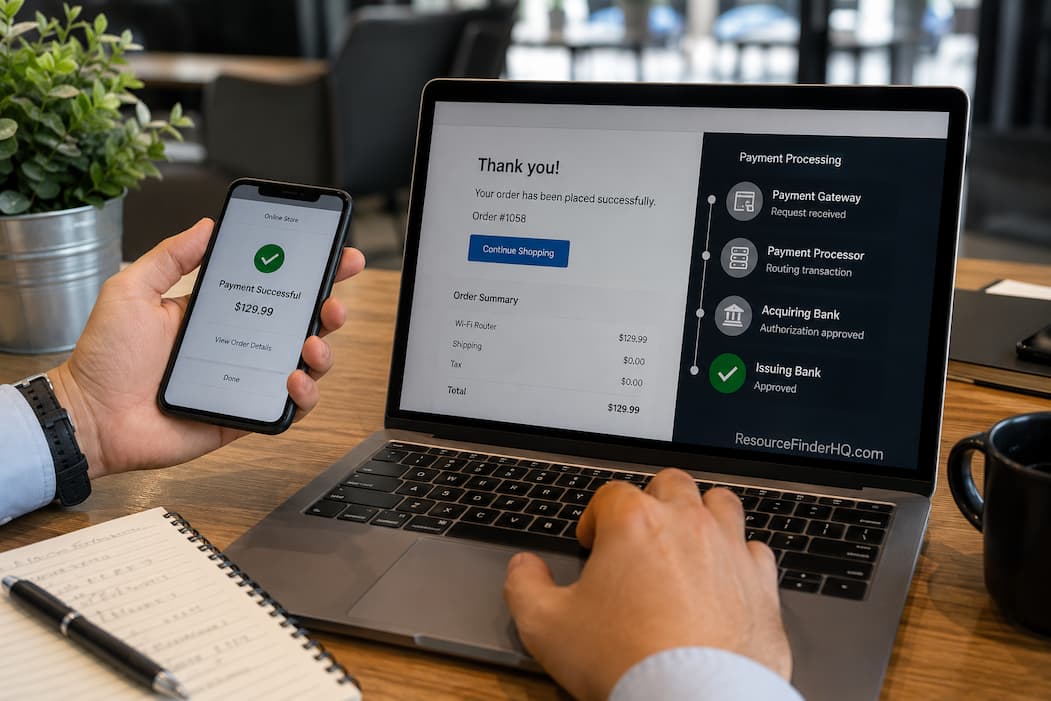
A customer clicks ‘Pay Now‘ on the website of an online store selling computer parts. The page pauses briefly, a loading animation appears, and two seconds later, the order is confirmed. The customer assumes the entire payment process is handled by a single system.
However, this is not the case.
Behind this confirmation page lies a brief collaboration between multiple independent institutions to ultimately complete the transaction. No single institution can handle the entire process alone. One institution receives the payment request, another forwards it via a financial network, another acts as the merchant’s bank, and yet another issues the card. Each player performs a specific role—much like athletes in a relay race—passing the transaction from one system to the next.
Naturally, three roles are most easily overlooked: the payment provider, the payment processor, and the acquiring bank (often simply called the acquirer). These terms frequently appear together in payment documents, merchant contracts, and technical descriptions, leading many people to mistakenly believe they describe the same service.
That is not the case.
Although they often work together, each link in the chain has different goals, plays a different role, and bears different technical and financial responsibilities. Understanding this makes it easier to grasp how online payments work and where the boundaries between the various stages lie.
One Purchase, Three Specialists
Imagine a small online business selling networking equipment. A customer adds a new Wi-Fi router to their shopping cart, enters their payment details, and purchases the item.
The website is not directly connected to every bank in the world. It does not have its own communication channels with all the card networks, nor does it decide on its own whether the payment is accepted. Instead, the merchant relies on a specialized payment infrastructure.
The payment gateway is usually the first player involved.
The gateway’s role begins the moment the customer enters their payment details.
The gateway does not make financial decisions; instead, it prepares the transaction for secure communication. It verifies the payment request to ensure all relevant information is complete, applies security measures where necessary, and then forwards the request to the broader payment system.
The payment gateway serves as the secure entry point to the payment network, but the transaction itself must be initiated by an institution via that network.
The payment processor performs this task.
The Payment Gateway Is the Merchant’s Secure Front Door
We can view the payment gateway as a translator and traffic controller acting on behalf of the merchant.
Online stores, mobile applications, subscription platforms, and business software generate payment requests in slightly different ways. However, banks and card networks all require transactions to use specific communication protocols.
Payment gateways connect these two ecosystems.
When a customer enters payment details, the payment gateway receives the request, performs an initial verification, and prepares the transaction for secure transmission.
This preparation typically involves checking that the necessary information has been provided, confirming the merchant is authorized to process the payment, and ensuring the request complies with the technical rules required by the underlying payment systems.
These steps are invisible to the customer but help prevent erroneous or incomplete transactions from entering the payment network.
Another key responsibility is ensuring the security of sensitive payment data during transmission between systems. Instead of requiring every merchant application to communicate with financial institutions, a payment gateway provides a common communication layer that merchants integrate once and can continue using as payment infrastructure evolves.
This simplifies the payment integration process for businesses. Merchants do not need to re-establish connections with each partner bank or card network when updating their websites, as the payment gateway continues to manage these communications.
Every Payment Gateway is Different
Although a payment gateway might sound like a single product, in reality, it can take many forms depending on how a merchant operates.
Some businesses redirect customers to a hosted payment page managed by the gateway provider. Others integrate payment forms directly into their own websites and use the gateway to securely process data in the background.
Large enterprises sometimes integrate gateway services directly into custom checkout systems that span websites, mobile apps, and physical stores.
While these implementations differ, they all share the same goal: creating a secure and reliable entry point to the payment system while avoiding excessive technical complexity for merchants.
That is why businesses—from small online shops to large international retailers—often use the same gateway technologies, even though the checkout experiences can vary significantly.
The Processor Keeps the Transaction Moving
Once the gateway has successfully prepared the payment request, another participant assumes responsibility.
The payment processor acts as the operational engine responsible for transporting transaction information between financial institutions.
Unlike the gateway, which primarily represents the merchant’s side of the transaction, the processor focuses on maintaining communication throughout the payment network.
This involves routing authorization requests toward the correct destination, receiving responses from issuing banks, and returning those responses through the payment chain so the merchant can display the outcome to the customer.
Processing millions of transactions each day requires extremely reliable infrastructure.
Processors operate systems capable of handling enormous transaction volumes while maintaining low latency, high availability, and continuous monitoring.
A temporary interruption lasting only a few minutes could affect thousands—or even millions—of attempted purchases around the world.
Because of this, processors invest heavily in redundant infrastructure, automated failover systems, and continuous operational monitoring designed to keep payment traffic flowing even when individual components experience technical problems.
The processor isn’t deciding whether the customer should be allowed to make a purchase.
Instead, it ensures the right request reaches the right institution as efficiently and reliably as possible.
Routing Is More Complex Than It Appears
A customer may believe a payment simply travels from the store directly to their bank.
The actual routing process is considerably more sophisticated.
Before an authorization request reaches the issuing bank, several routing decisions may occur based on factors such as the card network, transaction currency, merchant location, payment method, and contractual relationships between financial institutions.
The processor evaluates these routing requirements almost instantly.
Two customers purchasing the same product from the same merchant could see their transactions follow slightly different paths because their cards belong to different issuing banks or payment networks.
These differences remain invisible to both customers and merchants, yet they demonstrate why processors play such an important operational role.
Rather than functioning as a simple communication channel, they continuously coordinate transaction movement across a highly interconnected financial ecosystem.
Where the Acquirer Enters the Story
Until now, the transaction has focused primarily on obtaining authorization from the customer’s financial institution.
Eventually another important question must be answered:
Who represents the merchant’s financial interests?
That responsibility belongs to the acquiring bank, commonly called the acquirer.
If the issuing bank maintains the customer’s payment account, the acquiring bank maintains the merchant’s payment relationship.
When a business begins accepting card payments, it typically establishes that capability through an acquiring institution or a payment service provider working with one.
The acquiring bank enables the merchant to participate in card payment networks, receives settled funds after successful transactions, manages merchant payment accounts, and coordinates financial settlement with other participating institutions.
Unlike gateways and processors, whose primary responsibilities involve communication and transaction movement, the acquirer has a direct financial relationship with the merchant.
It is through this relationship that approved transactions eventually become deposited funds in the merchant’s business account.
For many merchants, the acquiring bank remains largely invisible during day-to-day operations because much of the technical communication is handled by gateways and processors. Nevertheless, the acquirer remains one of the essential financial participants that makes electronic card acceptance possible.
When One Company Performs Multiple Roles
The payment industry has evolved rapidly over the past decade, and with that evolution, the boundaries between gateways, processors, and acquiring services have become less obvious.
A business owner researching payment providers today may discover that a single company offers gateway services, payment processing, merchant accounts, fraud detection, recurring billing, analytics, and settlement reporting through one platform. From the merchant’s perspective, it feels like one unified service.
Behind the scenes, however, the underlying responsibilities haven’t disappeared.
A payment provider may operate its own gateway while partnering with several acquiring banks. Another company may process transactions but rely on third-party gateways for merchant integrations. Some providers own much of the infrastructure themselves, while others coordinate specialized partners that each contribute part of the payment lifecycle.
This is why two businesses using the same payment provider can still have different settlement schedules, fee structures, or available payment methods. The customer-facing brand may be identical, but the financial relationships supporting those merchants can differ considerably.
For merchants, this abstraction is beneficial. They can focus on running their business without needing to understand every technical relationship behind each transaction. For anyone studying payment infrastructure, however, recognizing these separate roles makes the ecosystem much easier to understand.
Following the Transaction Beyond Authorization
Receiving an “Approved” response is often mistaken for the end of the payment journey.
In reality, authorization simply confirms that the issuing bank is willing to honor the purchase according to its current evaluation. The actual financial transfer takes place later through clearing and settlement.
At this stage, the acquiring bank becomes increasingly important.
It receives settlement information, reconciles completed transactions, applies agreed processing fees, and deposits the remaining funds into the merchant’s account according to the settlement schedule.
The timeline varies from one merchant to another. Some businesses receive funds the next business day, while others operate under longer settlement cycles based on contractual agreements, industry risk profiles, or local banking practices.
This delay explains why a customer can leave a store with a purchased item while the merchant has not yet physically received the money.
The payment ecosystem separates authorization from settlement because doing so improves efficiency and allows financial institutions to reconcile enormous numbers of transactions with greater accuracy.
Why Separating These Roles Makes the System Stronger
At first glance, dividing payment responsibilities among multiple organizations may appear unnecessarily complicated.
A natural question follows:
Wouldn’t it be easier if one organization simply handled everything?
In practice, specialization offers significant advantages.
A payment gateway can focus on secure merchant integrations without also managing banking relationships. Processors can concentrate on transaction routing and operational reliability. Acquiring banks can dedicate their resources to financial settlement, regulatory compliance, and merchant account management.
This separation allows each participant to improve its own systems without requiring the rest of the payment ecosystem to change simultaneously.
For example, a processor may upgrade its routing infrastructure to reduce authorization times without requiring merchants to redesign their checkout pages. Likewise, an acquiring bank can introduce new settlement services without affecting how payment gateways collect customer information.
The result is a payment ecosystem capable of evolving gradually rather than requiring disruptive, industry-wide redesigns whenever technology advances.
Choosing Payment Infrastructure as a Merchant
For a customer, the differences between gateways, processors, and acquirers remain almost invisible.
For merchants, however, those differences can influence day-to-day operations.
When evaluating payment solutions, businesses often compare factors such as integration options, supported payment methods, settlement schedules, reporting capabilities, international payment support, and customer service.
Some merchants prioritize flexible developer tools because they operate custom e-commerce platforms. Others value simplified setup, allowing them to begin accepting payments quickly with minimal technical effort.
Larger organizations may also consider redundancy by maintaining relationships with multiple processors or acquiring partners. This approach helps reduce operational risk if one payment route experiences temporary disruption.
These decisions illustrate that payment infrastructure is not simply a technical necessity. It also becomes part of a merchant’s broader operational strategy.
Comparing the Three Roles
Although they frequently cooperate within the same transaction, each participant contributes something fundamentally different.
| Participant | Primary Responsibility | Represents |
|---|---|---|
| Payment Gateway | Securely receives, validates, and forwards payment requests | The merchant’s checkout environment |
| Payment Processor | Routes transaction information between financial institutions | Operational payment infrastructure |
| Acquiring Bank (Acquirer) | Maintains the merchant account and receives settled funds | The merchant’s banking relationship |
Looking at the payment flow this way makes it easier to understand why the terms should not be used interchangeably.
The gateway opens the conversation.
The processor carries the conversation.
The acquiring bank completes the merchant’s financial side of the conversation.
Each depends on the others, yet each performs a distinct role.
A Practical Way to Visualize the Flow
Imagine sending an important international package.
You hand it to a local shipping office. That office checks the address, verifies the shipment details, and accepts the package.
The parcel then moves through regional sorting centers, transportation networks, customs inspections if necessary, and finally reaches the delivery office responsible for the recipient.
Although customers often remember only the shipping company printed on the label, several specialized facilities participated before the package arrived.
Electronic payments work in much the same way.
The gateway accepts the payment request.
The processor ensures it travels through the appropriate financial routes.
The acquiring bank ultimately manages the merchant’s financial receipt of the transaction.
The customer experiences a single purchase, but behind that purchase is a coordinated network of specialists, each responsible for one critical portion of the journey.
Conclusion
Modern electronic payments appear simple because their complexity is masked by the underlying infrastructure. Buyers enter their payment details, confirm their purchase, and receive the result almost instantly. They rarely consider how many companies must briefly collaborate to make this happen.
Payment gateways, payment processors, and acquiring banks each face their own unique challenges within this process. One provides a secure access point, another transmits transaction data within the financial network, and the third establishes financial connections between merchants and the broader payment system. They are indispensable; no single entity can handle the entire transaction independently.
Understanding these differences is essential to grasping a crucial element of the current payment system: its strength stems from specialization. By assigning responsibilities to specialists in various fields, the sector has built an infrastructure capable of processing billions of transactions annually. Moreover, this infrastructure is constantly evolving to accommodate new payment technologies, changing security requirements, and the growing needs of businesses and consumers.
FAQs
Can a merchant work directly with an acquiring bank without using a payment gateway?
Yes, sometimes. Larger companies with their own payment infrastructure can set up more direct integrations. However, most organizations use payment gateways or payment service providers because these streamline secure communication processes and reduce technical complexity.
Does the payment processor ever approve a transaction?
No. Payment processors handle authorization requests and responses, but the final approval is typically granted by the issuing bank after evaluating the transaction.
Why do some payment service providers market themselves as “one-stop” providers?
Many providers offer integrated platforms that include gateway services, payment processing, fraud monitoring, and merchant account services. This makes it easier for merchants to go live, though ultimate responsibility remains with the payment system.
Does switching payment processors affect checkout performance?
Yes. Different payment processors vary in functionality—including routing capabilities, geographic coverage, reliability, and partnerships with financial institutions. These differences can impact authorization speed and overall transaction performance.