
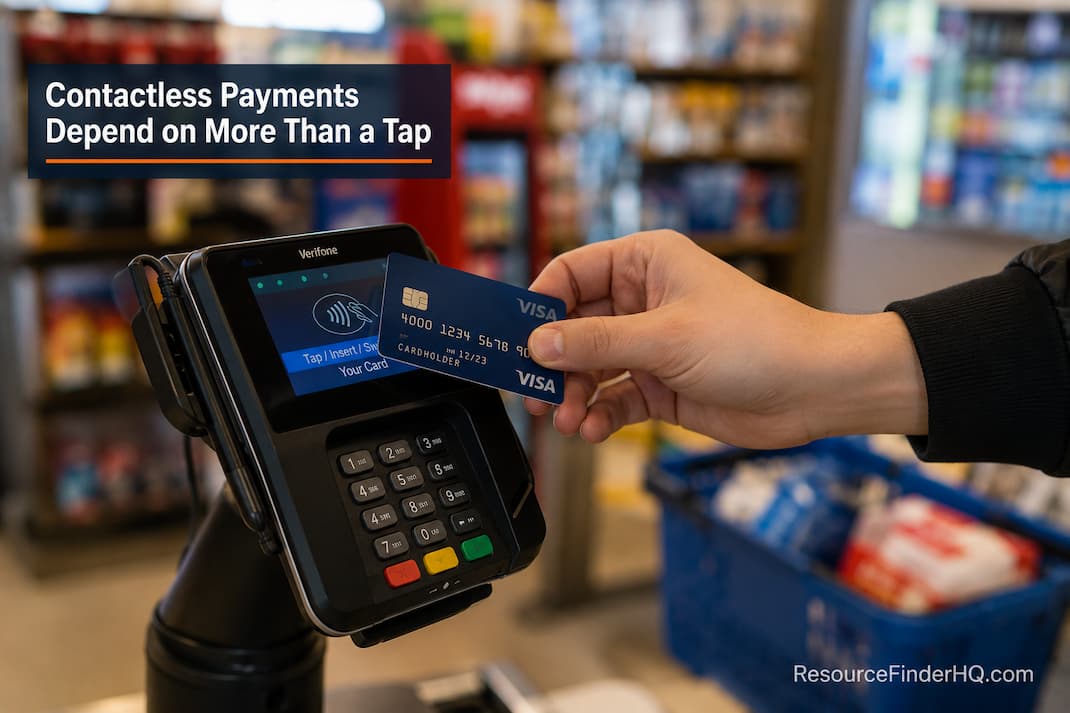
Standing just centimeters away from the reader, customers present their bank cards for payment, wait for a brief beep, and then they are free to leave with their receipt. The whole process takes only a fraction of the time it would take to insert a chip card or hunt for cash. People may mistakenly assume that contactless technology just involves wirelessly transmitting card details to the machine due to the convenience of this payment option. However, if that were true, using a card would significantly compromise security. Anyone having access to the appropriate software may potentially impersonate a real consumer, replicate transactions, or steal payment information from adjacent cards. To avoid these problems, new contactless payment technologies were developed.
In reality, several technologies collaborate to make the rapid tap that consumers experience possible. There is a radio connection between the terminals and the cards. After a series of steps—including encryption to ensure the card is legitimate, routing by the payment network to the appropriate terminal, approval by the issuing bank, and background assessment by a fraud detection system—the cashier receives a response. There is a lot more to it than just wireless communication. Once you know how contactless payment works, you’ll understand why it’s becoming more and more common, from paying for coffee and public transportation to big retail purchases all around the world.
Beyond the Term “Wireless Cards”
Some initially mistook contactless payment cards for regular old plastic since they didn’t require any sort of swipe or insert. Although the explanation does take the convenience into consideration, it fails to address the underlying technological principles of the technology. In addition to transmitting payment details when near a terminal, contactless payment cards have many other uses as well. They have a secure microchip embedded in them, just like the ones used in regular EMV transactions. The way the chips talk to each other is what makes it unique.
There is no need to physically touch the payment terminal in order for this chip to communicate with it. Data transfer does not commence until the card gets within the terminal’s active range, which is often no more than a few centimeters. The design reflects a conscious decision. The consumer must physically bring the card near the terminal to start the payment process, thanks to the technology. You can’t just stroll around a mall or stand close to a payment machine and expect to be charged. The communication process between the card and the terminal is significantly more intricate than the average person would think.
Diminishing Intervals in Discourse
A lot of data is transferred between the card and the terminal before the purchase is processed, even though it seems like it happens instantaneously when you swipe a card. The transaction flow is determined by the terminal after it identifies the available payment methods on the card. While the security chip encrypts critical data, the card sends the necessary authentication information. Despite the rapidity of this contact, it is not haphazard.
A business’s payment terminal may trustworthily process cards issued by banks around the globe because every step adheres to globally accepted standards. Global electronic payments would be much more complicated if all issuing institutions were required to use specialized terminals, which is not the case due to these universal standards. Millions of businesses can take contactless payments thanks to standardized communication, which eliminates the need for individual terminals at each bank or issuing institution.
Why Tapping Doesn’t Send Your Card Number Flying
The idea that terminals can just pick up card numbers through radio signals is a common but false assumption concerning contactless payment. In fact, there are many more components involved. Depending on the chosen payment method, transactions may use tokenization, dynamic authentication, or a mix of the two. To ensure that a payment was started by a valid device, modern payment systems create transaction-specific information rather than just transmitting the same payment details again and again.
Because of these developments and other factors, current contactless payments are very different from their static-information-based predecessors, the magnetic-stripe payment systems. Both systems let users conduct financial transactions online, but they use quite different security structures. At first glance, two different contactless payments made at the register could seem very similar. All the same, the payment system handles these transactions separately, as if they were separate events, each supported by its own authentication data.
An Overview of Contactless Communication Technology
The Near Field Communication (NFC) wireless technology is the backbone of contactless payment systems. NFC can be used for more than just payments and debit cards. Countless gadgets depend on this essential technology that allows for the transfer of small data packets over short distances. This includes smartphones, smartwatches, public transportation cards, hotel access control systems, and many more. One big plus of NFC is its short range.
Near Field Communication (NFC) is different from technologies that aim to communicate across buildings or rooms since it only functions when users purposefully bring their devices close together. As a result, users are able to tap their credit cards against the device at their convenience without worrying about unintentional encounters. For a brief period of time, the payment terminal establishes a connection with the card by producing a tiny electromagnetic field. The security chip will activate, and data exchange will commence to complete the transaction as long as the card stays within this field. From the buyer’s perspective, everything happens so fast that they might not even notice when the transaction is finished—just a little notification on the screen or a beep from the payment terminal. But getting there quickly isn’t the only goal. To think that contactless payments were made to accelerate the checkout process is naive.
Prioritizing Quickness Was Always a Good Idea
In addition to improving security and dependability, payment networks strive for backward compatibility with current financial infrastructure. The goal of rapidly developing contactless payment systems is not to replace the current payment infrastructure, but to complement it by easily integrating with EMV standards, existing card networks, payment gateways, acquiring banks, and issuing banks.
Retailers can gradually upgrade their terminals without having to construct new payment environments from the ground up. This change provides more ease for buyers. Your go-to payment methods haven’t altered much, but you’ve noticed a dramatic improvement in many aspects of your usual buying experience. One reason for the quick adoption of contactless payments in stores, restaurants, public transportation, and self-service kiosks is this clever balance between innovation and compatibility.
One Touch, Various Platforms
The very first tap of a customer’s card is just the tip of the iceberg when it comes to the payment process. Approval shows on the terminal after information flows through multiple separate organizations in seconds.
- It all starts with the contactless reader.
- The safe chip verifies its identity.
- The payment gateway prepares the request.
- The money goes through the right card network because of the payment processor.
- Before returning an authorization decision, the issuing bank reviews the available funds, account status, and fraud signs.
By the time the consumer takes their shopping bag, numerous companies have already played unseen but integral roles in the transaction. The apparent simplicity of contactless payments belies their reliance on one of the most complex financial infrastructures in the world, thanks in part to this unseen coordination.
Differences Between Mobile Wallets and Contactless Payments
The experience of using a bank card at a checkout counter and using a smartphone to make a purchase can be very similar. Both processes are facilitated by a single tap, typically finish in a matter of seconds, and do away with the necessity of inserting a card into a reader. But they don’t necessarily move in lockstep behind the scenes. The secure chip inside a contactless payment card allows it to communicate with the terminal in a direct fashion. Before a transaction reaches the terminal, a mobile wallet manages the payment credentials using the phone’s secure hardware and operating system, adding an extra layer of protection.
During the purchase, mobile wallet implementations sometimes do not display the real card number. Rather, the underlying account is represented by a payment token. No physical card number is transmitted to the store; however, the payment network and the issuing bank can still identify the purchasing account. Because of this method, unlike with a regular credit card, the loss of a phone does not immediately reveal all of the cardholder’s financial information. The payment information kept in a mobile wallet is handled differently, and it is frequently possible to deactivate it remotely without physically canceling the card. There may be more layers to the technology that allows a smartphone payment to work, even though the consumer still uses the same “tap to pay” gesture as when using a real card.
The Opportune Occurrence of PIN Requests in Contactless Payments
Tapping a card for smaller purchases instead of entering a PIN or signing a receipt has become a common practice for many shoppers. The next day, the terminal requests extra verification for no apparent reason. In most cases, the request isn’t a problem. Before determining if additional verification is necessary, payment systems consider several parameters. Any one of the following could be causing the payment system to request more confirmation: the purchase amount is too high, the issuing bank wants tighter client authentication, or it just thinks it would be safer.
Other factors besides the payment terminal are also considered. Additional verification may or may not be necessary, depending on the issuing bank’s processing of the payment. Whenever the payment ecosystem thinks it’s necessary, contactless payments can support stricter authentication, keeping them handy for everyday purchases.
Multiple Layers, Not Just One, Are Necessary for Security.
An often-asked question is whether or not contactless payments are “safe.” The question may seem simple, yet there is more complexity to the solution. No method of electronic payment can be deemed foolproof based on a single characteristic. Instead, contemporary payment systems depend on a number of separate but complementary layers of security. One possible component of a contactless transaction is
- Cryptographic authentication is performed by a secure EMV chip.
- near-field communication (NFC) that is only effective at extremely short distances.
- Data that is dynamic and changes as a result of transactions.
- The issuing bank keeps an eye out for fraud in real time.
- Complete risk assessment of the payment system implemented.
Even if one of the layers were removed, the remaining layers would still protect the transaction. Even though electronic payment methods have been faster and more convenient, security has continued to improve, in part because of this layered design.
The Rapid Adoption of Contactless Technology by Businesses
Contactless payments are commonly associated with ease for consumers, but there were strong incentives for retailers to adopt the technology as well. Shortening the time it takes for a customer to make a purchase might not seem like much, but in settings where hundreds or thousands of customers make transactions daily, even a few seconds can make a big impact. Having a way for customers to pay that doesn’t involve inserting cards or handling cash is a huge help to busy cafes, grocery stores, pharmacies, and transit systems.
The technology was also an obvious choice for the industry’s larger transition to online payment processing. Adding contactless functionality was more of an afterthought than a distinct infrastructure effort, as many companies were already upgrading their payment terminals to handle EMV chip transactions. Familiarity was another benefit. Contactless cards, in contrast to totally novel payment mechanisms, needed little in the way of explanation. Customers could still use their existing bank cards, but now they could complete qualified purchases faster. Contactless payments have grown rapidly in many regions of the world due to the combination of their ease of use, compatibility, and increased security.
Common Misunderstandings About Contactless Payments
As with many technologies that become part of everyday life, misconceptions surround contactless payments. Some arise from outdated information, while others result from comparing today’s payment systems with much older technologies.
| Misconception | What Actually Happens |
|---|---|
| The card continuously broadcasts payment information. | Communication begins only when the card enters the terminal’s short operating range. |
| Every tap sends the same payment credentials. | Modern contactless transactions use dynamic authentication and may also involve tokenization. |
| Contactless payments skip bank authorization. | The issuing bank still evaluates the transaction before approving or declining it. |
| A tap is simply a wireless version of swiping a magnetic stripe. | Contactless payments rely on EMV-based security standards rather than static magnetic stripe data. |
Understanding these distinctions helps explain why contactless technology became widely accepted despite the concerns that accompanied its introduction.
Looking Beyond the Checkout Counter
Contactless card payment technology is also impacting an increasing number of commonplace services. More and more, riders of public transit can skip buying individual tickets and pay with a tap of a credit card or mobile device. You can now use contactless payments at many places, including self-service vending machines, parking lots, event centers, and even some hospitals.
The familiar tap might show up in locations other than conventional checkouts as more linked devices can securely process payments. The core premise that has not changed is simplifying the customer’s experience while maintaining the security standards that protect financial transactions. Contactless technology has evolved into a platform that other new payment experiences are building upon, rather than being the pinnacle of payment innovation in and of itself.
Conclusion
Because contactless payments are so straightforward, it’s deceptively simple to miss the complexity lurking behind the surface. What appears to be a brief tap is really the product of second-by-second coordination of communication among secure chips, payment terminals, banks, card networks, and fraud detection systems.
Thanks to this unseen coordination, contactless payments have grown a reliable option for millions of regular purchases. The secret to the technology’s success lies in its ability to conceal complexity from the consumer while maintaining the security measures necessary for current payment systems to remain dependable. The ubiquitous tap will probably always be one of the best instances of how advanced technology can make something seem so simple, no matter how the future of commerce develops.
FAQs
1. Can a contactless payment still be handled even if the internet goes down for a bit?
Terminals for accepting payments may have restricted offline capabilities in certain cases; the answer is contingent upon the merchant’s setup and the regulations of the payment network. Nevertheless, it is still necessary to communicate with payment systems for many transactions before they are approved.
2. Is it faster to insert a payment card than to tap it?
The lack of physical contact between the chip and the terminal in contactless payments actually has the potential to reduce wear and tear on the card’s contact points over time; thus, the answer is usually no.
3. Are two contactless cards capable of simultaneous charging?
A payment terminal can only use one payment credential at a time. It is common practice for terminals to reject transactions involving numerous contactless cards or devices being used at the same time and request that the consumer try again with a single card or device.
4. Is the chip-and-PIN transaction giving way to contactless payments?
Not totally. The equipment of the merchant, the requirements of the issuing bank, the circumstances of the transaction, and local payment practices determine which technique is most appropriate; both methods coexist.