
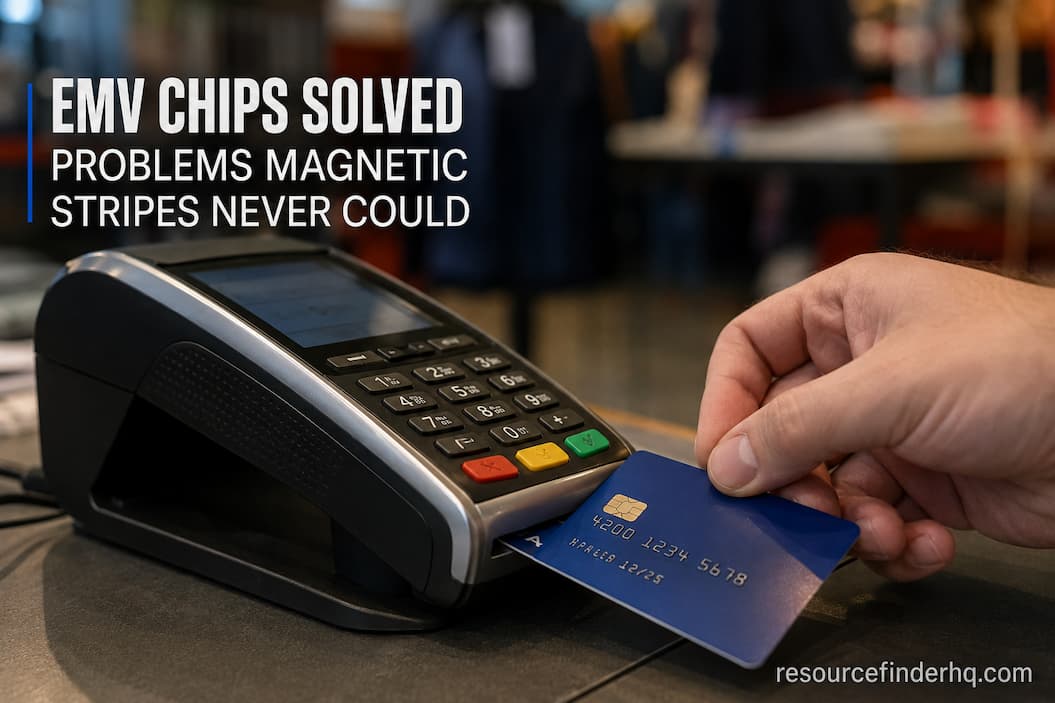
Debit and credit cards have long been a part of everyday life. Cashiers swipe cards with magnetic stripes through a reader that scans the information on the back and confirms the transaction within seconds. This method is simple and efficient, and electronic payment has become an integral part of daily life worldwide. However, this convenience masks a growing vulnerability.
The data on the magnetic stripe rarely changes. Each time a card is scanned, virtually identical payment details are sent to the payment system. While this consistency speeds up transactions, it also creates an opportunity for thieves. If someone manages to extract data from the magnetic stripe, they can often replicate that information onto another card and carry out fraudulent transactions. As payment fraud becomes increasingly sophisticated and data theft techniques simpler, the payment industry can no longer ignore the limitations of magnetic stripe cards.
One of the most significant developments in modern payment security is the adoption of EMV chip technology. EMV chips do more than just store payment data; they revolutionize the way cards authenticate themselves during transactions. Unlike static data that can be copied, every transaction generates unique, encrypted information valid only for that specific transaction.
What is truly remarkable is that this major security upgrade requires minimal effort from the consumer. You still swipe or tap your card against the payment terminal for contactless payments, but a completely new identity verification process takes place behind this familiar action. EMV technology has not changed how people pay; it has changed how payment systems verify the authenticity of transactions. To understand the need for EMV chips, we must look back at how magnetic stripe technology worked, how it served the industry well for years, and why it ultimately could not meet the growing demands of modern electronic payments.
The Era of the Magnetic Stripe
The advent of magnetic stripe cards in the second half of the 20th century represented a major improvement over paper-based payment methods. Merchants could process payments faster and more reliably without relying on manual verification.
A magnetic stripe is a narrow strip of data containing crucial payment information. When a card is swiped through a reader, the terminal extracts this information and sends it to the payment network for authorization.
For years, this method was highly successful because payment systems were relatively centralized, e-commerce was still in its infancy, and organized payment fraud was far less sophisticated than it is today.
The success of magnetic stripes was also driven by their ease of use. They were inexpensive to produce, compatible with millions of payment terminals, and relatively simple for merchants to implement. As international payment networks continued to develop, magnetic stripe cards gradually became a universal standard, allowing customers to use them in virtually any store that accepted electronic card payments.
From a technical standpoint, magnetic stripes solved many of the problems associated with early electronic payments. Their eventual failure was not due to design flaws, but rather to the rapid evolution of digital commerce and payment fraud.
The Growing Security Risks Associated with Static Data
The primary issue with magnetic stripe technology is its reliance on payment data at rest.
Every time a customer uses a bank card, the magnetic stripe presents the same stored information to the payment terminal. While banks and payment networks may perform security checks to identify suspicious activity, the card itself offers virtually no protection if the data is stolen.
The rapid evolution of payment technologies has opened the door to attacks.
One of the most notorious examples is bank card fraud. Criminals install unauthorized reading devices on payment terminals or ATMs. These devices capture the information encoded on the magnetic stripe whenever a customer uses their card, without the customer’s knowledge.
The stolen data so closely resembles the original information that criminals can sometimes use it to create counterfeit cards that are virtually indistinguishable from genuine ones.
The problem goes beyond the mere theft of information. A more significant issue is that payment systems often struggle to distinguish between genuine and counterfeit cards, as their authentication data is nearly identical.
As the volume of electronic payment transactions continues to grow globally, this vulnerability takes an increasingly heavy toll on financial institutions, retailers, and consumers.
Fraud Evolved Faster Than the Technology
Magnetic stripe technology originated in an era when threats to payment systems differed significantly from those faced today.
Over time, however, fraudsters have developed increasingly sophisticated methods to obtain payment data, create counterfeit cards, and exploit vulnerabilities in authentication procedures. At the same time, the rise of international travel, online shopping, and ATMs has led to a dramatic increase in the use of payment cards.
These developments brought about new security challenges that the original magnetic stripe architecture simply could not address.
To tackle these issues, financial institutions enhanced their fraud detection systems and transaction analysis capabilities, and implemented additional security controls. While these measures have curbed certain types of fraud to some extent, they can only identify suspicious activity after payment details have been entered into the system.
The payment industry gradually realized that improving fraud detection capabilities does not solve the fundamental problem.
The authentication process itself needs to be more secure.
EMV Introduced a Different Way to Prove Authenticity
EMV technology no longer merely asks whether the payment details are correct; it poses a more critical question:
Can this card prove its authenticity?
This distinction has revolutionized payment authentication methods.
EMV chips are equipped with a secure microprocessor that encrypts every transaction, rather than relying primarily on static information stored on the card.
When the card is inserted into a compatible payment terminal, communication between the chip and the terminal follows a preset sequence. During this process, the chip generates unique encrypted data for each specific transaction.
This information is generated dynamically, making it impossible to copy it from one transaction to another successfully.
Consequently, even if someone intercepts the communication from a completed EMV transaction, the authentication data cannot be used for future transactions. This is one of the key differences between magnetic stripe card authentication and EMV authentication.
EMV Is More Than Just a Chip
Many people think the visible metallic square on a payment card is the security feature itself.
In reality, the metal contacts merely provide communication between the payment terminal and the secure integrated circuit embedded within the card.
Inside that tiny microprocessor is specialized software capable of securely storing cryptographic keys, processing authentication requests, and participating in payment authorization without exposing sensitive information.
Unlike magnetic stripes, which function primarily as storage media, EMV chips actively participate in the transaction.
They can:
- Verify transaction information.
- Generate unique authentication values.
- Support different verification methods.
- Communicate securely with payment terminals.
- Follow internationally recognized payment standards.
This ability to perform secure computations is what transformed payment cards from passive storage devices into active participants in payment security.
Why Copying an EMV Chip Is Much More Difficult
One of EMV’s greatest achievements is that it significantly reduced the value of simply copying payment information.
With magnetic stripe cards, duplicating the stored data could sometimes produce a functioning counterfeit card because the authentication information remained largely unchanged.
EMV chips operate differently.
Each transaction depends on cryptographic calculations performed inside the secure chip itself. Those calculations rely on confidential information that is designed to remain protected throughout the card’s lifetime.
As a result, copying visible payment information or intercepting transaction messages does not provide enough information to reproduce the authentication process performed by the genuine chip.
This doesn’t mean EMV makes payment fraud impossible. No payment technology can eliminate every threat.
Instead, EMV changes the economics of fraud by making one of the most common attack methods—counterfeit card creation—significantly more difficult and far less profitable than it was during the magnetic stripe era.
Magnetic Stripe and EMV: A Different Approach to Authentication
Although both technologies allow customers to pay with a physical card, the underlying authentication process differs considerably.
| Feature | Magnetic Stripe | EMV Chip |
|---|---|---|
| Authentication data | Mostly static | Dynamic for each transaction |
| Card behavior | Stores information | Processes and authenticates information |
| Counterfeit resistance | Limited | Significantly stronger |
| Security approach | Verify stored data | Verify the genuine card through cryptography |
| Support for modern payment security | Limited | Designed for evolving payment ecosystems |
The transition from magnetic stripes to EMV chips was not simply a hardware upgrade. It represented a shift in how payment systems establish trust between the card, the payment terminal, and the issuing bank.
Rather than assuming stored information is sufficient proof of authenticity, EMV introduced the ability for each transaction to demonstrate that it originated from a legitimate payment card.
How an EMV Transaction Works Behind the Scenes
From a customer’s perspective, an EMV transaction appears almost effortless. The card is inserted into the payment terminal, a few seconds pass, and the purchase is approved. Behind those few seconds, however, several coordinated systems exchange information to confirm that the transaction is genuine.
Unlike magnetic stripe transactions, where the terminal primarily reads stored information, an EMV payment begins with a conversation between the chip and the payment terminal.
The terminal first identifies the applications supported by the card and determines how the transaction should proceed. The chip then responds by providing specific information needed for authentication while keeping its most sensitive cryptographic material securely protected inside the chip itself.
As the transaction progresses, the chip generates a unique cryptographic value based on details such as the purchase amount, terminal information, and transaction sequence. This value becomes part of the authorization request sent through the payment network.
Because the authentication data is unique to that transaction, replaying it later offers little practical value. Even if someone intercepted the communication, the issuing bank expects different authentication information during the next purchase.
Although this entire exchange takes only moments, it fundamentally changes how payment systems evaluate trust.
Why Every Transaction Looks Different
One of EMV’s greatest strengths is that it avoids repeating the same authentication data.
With magnetic stripe technology, every successful swipe looked remarkably similar because the underlying information rarely changed. EMV introduces variability into every purchase.
Imagine two customers buying the same item from the same store within a few minutes of each other. Even if they used the same payment card, the authentication information generated during each transaction would be different because the chip incorporates transaction-specific data into its cryptographic calculations.
This dynamic behavior provides financial institutions with stronger evidence that the card participating in the transaction is physically present and actively responding to the payment terminal.
It also makes large-scale counterfeit card fraud considerably more difficult than it was during the magnetic stripe era.
The Relationship Between EMV and Contactless Payments
Many people associate EMV exclusively with inserting a card into a terminal, but EMV standards also support many contactless card payments.
Whether a customer inserts a card or taps it using Near Field Communication (NFC), the underlying security principles remain similar. The payment still relies on dynamic authentication rather than static card information.
The main difference lies in how the card communicates with the terminal.
An inserted card exchanges information through the chip’s physical contacts, while a contactless card communicates wirelessly over a very short distance. Despite this difference, both methods can use EMV security mechanisms to generate transaction-specific authentication data.
This explains why contactless payments are not simply “wireless magnetic stripe transactions.” Although the experience feels different, the underlying authentication architecture is based on modern EMV standards rather than older magnetic stripe technology.
EMV Did Not Eliminate Every Type of Payment Fraud
When EMV technology was introduced, some people assumed it would permanently solve payment fraud.
In reality, EMV was designed to address a specific problem: counterfeit card fraud resulting from copied magnetic stripe data.
As that type of fraud became more difficult, criminals shifted their attention toward other attack methods that do not depend on cloning physical cards.
Examples include:
- Phishing campaigns targeting online banking credentials.
- Account takeover through stolen passwords.
- Social engineering scams.
- Fraud involving compromised merchant accounts.
- Card-not-present fraud in online transactions.
This change illustrates an important principle in cybersecurity. Attackers often adapt when one technique becomes less effective.
Rather than replacing every other security measure, EMV became one layer within a broader payment security strategy that now includes tokenization, behavioral analytics, fraud detection engines, multi-factor authentication, and real-time risk assessment.
Why the Global Migration Took So Long
Although the benefits of EMV were substantial, introducing the technology across the payment ecosystem required more than simply issuing new cards.
Banks needed to replace millions of payment cards.
Merchants needed compatible payment terminals capable of communicating with EMV chips.
Payment processors updated software to support new transaction formats and authentication procedures.
Card networks introduced revised technical specifications to ensure interoperability across different countries and financial institutions.
For many businesses, upgrading hardware represented a significant investment. Smaller merchants often postponed replacing existing terminals until older equipment reached the end of its operational life.
International adoption also progressed at different speeds. Some countries completed their migration relatively quickly, while others maintained support for magnetic stripe transactions during an extended transition period to preserve compatibility with older payment infrastructure.
This gradual rollout explains why many payment cards still include both an EMV chip and a magnetic stripe today.
Why Magnetic Stripes Still Exist
At first glance, it may seem surprising that modern payment cards continue to include magnetic stripes despite the advantages of EMV technology.
The primary reason is compatibility.
Not every payment terminal worldwide immediately supported EMV transactions when the technology became available. Maintaining the magnetic stripe allowed cards to function in locations where older equipment remained in service.
Over time, however, reliance on magnetic stripes has steadily decreased as newer payment terminals have become standard across much of the world.
Many financial institutions are now moving toward payment cards that prioritize EMV and contactless technologies while gradually reducing dependence on legacy magnetic stripe functionality.
This transition reflects the payment industry’s ongoing effort to strengthen security without disrupting everyday commerce.
EMV and the Future of Card Payments
Although payment technology continues to evolve, EMV remains a central component of modern card-based payments.
Its standards continue to support innovations that extend well beyond traditional chip cards.
Today’s payment ecosystem increasingly combines EMV with technologies such as:
| Technology | How It Complements EMV |
|---|---|
| Tokenization | Replaces card numbers with secure payment tokens |
| Digital Wallets | Allow EMV-based credentials to be used on mobile devices |
| NFC | Enables secure contactless communication between cards or devices and terminals |
| Fraud Detection Systems | Analyze transaction patterns beyond card authentication |
| Biometric Authentication | Confirms the identity of the cardholder before payment begins |
Rather than becoming obsolete, EMV has adapted to support many of the payment methods consumers now use every day.
Its role has expanded from protecting physical cards to strengthening a much broader digital payment ecosystem.
Related ResourceFinderHQ Articles
If you’d like to explore the technologies that work alongside EMV, these topics provide the next logical steps:
- Following a Card Payment Through Seven Different Systems
- Tokenization Changed Card Security Without Changing How People Pay
- Contactless Payments Depend on More Than a Tap
- Payment Gateways, Processors, and Acquirers Inside One Transaction Flow
- Fraud Detection Begins Before a Payment Ever Reaches the Bank
- Digital Wallet Architecture Beyond Mobile Payment Apps
Frequently Asked Questions
Can an EMV chip stop every type of payment fraud?
No. EMV significantly reduces counterfeit card fraud by using dynamic authentication, but it does not prevent every form of fraud. Criminals continue to target online accounts, stolen credentials, phishing attacks, and other methods that fall outside the chip’s primary purpose.
Why does my card still have a magnetic stripe?
Many payment cards retain magnetic stripes to ensure compatibility with older payment terminals that have not yet fully transitioned to EMV technology. However, their importance continues to decline as newer infrastructure becomes more widespread.
Does an EMV chip store my PIN?
Generally, no. While EMV technology supports PIN verification in many payment environments, the PIN itself is not simply stored on the chip in plain text. The chip participates in secure verification processes designed to protect sensitive authentication information.
Is tapping a card less secure than inserting it?
Not necessarily. Many contactless transactions also use EMV security principles, generating dynamic authentication data for each payment. The communication method differs, but the underlying security architecture remains closely related.
Why are EMV transactions sometimes slower than magnetic stripe payments?
An EMV transaction involves additional authentication steps between the chip, payment terminal, and issuing bank. Although these exchanges require slightly more processing, they provide significantly stronger protection against counterfeit card fraud.
Closing Perspective
Magnetic stripe cards transformed electronic payments by making card transactions faster and more practical than the paper-based methods that came before them. Their design reflected the needs of an earlier era, when payment networks were smaller and fraud techniques were far less sophisticated.
EMV chips represent the next stage in that evolution. Instead of treating a payment card as a simple container for stored information, they allow it to actively prove its authenticity during every transaction through cryptographic processes that are extremely difficult to duplicate. That shift fundamentally changed how payment systems establish trust.
As digital wallets, contactless payments, and connected devices continue reshaping commerce, EMV remains one of the technologies quietly supporting those experiences. Most people will never notice the complex authentication taking place each time they insert or tap a card, yet those few seconds reflect decades of engineering aimed at solving problems that magnetic stripes were never designed to address.