
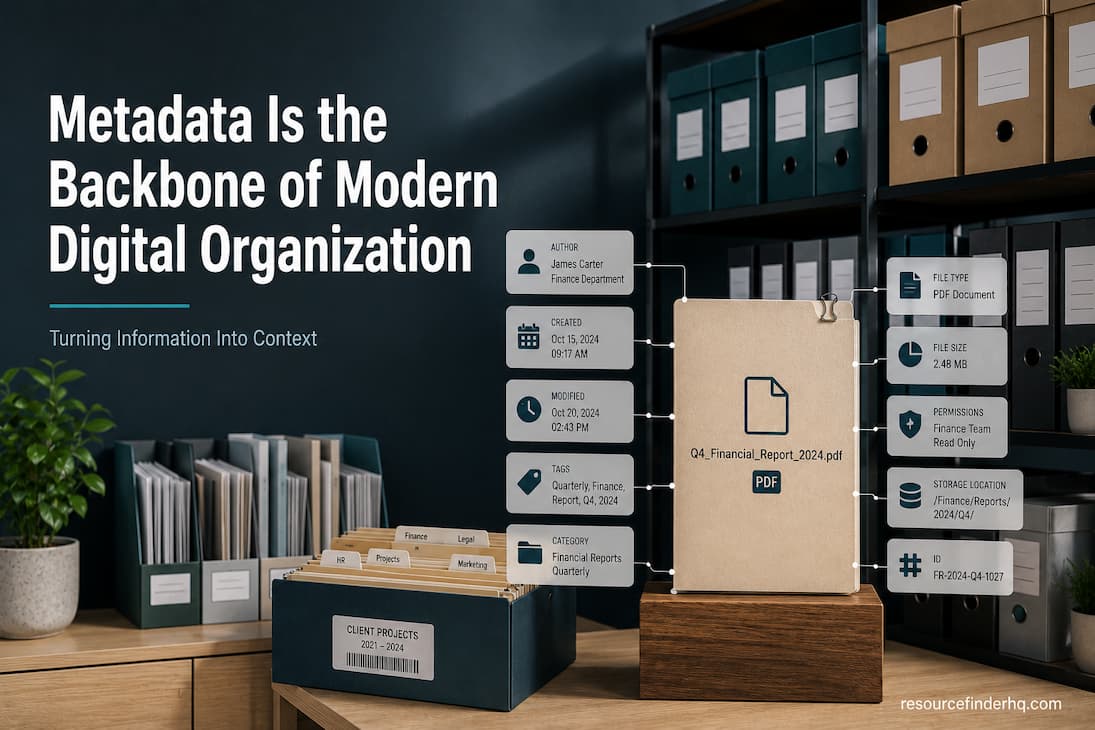
When you open a folder containing thousands of digital files, you primarily see content: reports, images, spreadsheets, presentations, or videos. However, this content usually hides an extra layer of information. File attributes include the file creator, the modification date, the format, the location, the application used to open the file, and much more. Metadata refers to this descriptive information; without this information, even small datasets would be difficult for modern digital systems to organize.
Now that modern digital environments no longer consist of hundreds of files, the importance of metadata is becoming increasingly clear. Companies process millions of documents in the cloud, news organizations store decades of videos and images, medical institutions maintain detailed patient records, and academic institutions store enormous amounts of scientific information. Simply storing this data in databases is insufficient. To efficiently locate, process, protect, and manage data, systems must also understand what each object represents.
Metadata Describes Information Without Being the Information
Metadata is often imperceptible during routine tasks, leading to widespread misunderstandings. When people open a document, they typically focus more on the content than on the associated descriptive attributes. The behavior of a file throughout its lifecycle often depends on these details.
Images are a good example. In addition to the image itself, metadata can contain information about the capture date, camera model, dimensions, shooting location, exposure settings, file format, ownership details, and more. This information works together to make searching, categorizing, and managing thousands of similar images much easier—details that do not actually change the appearance of a photo. This fundamental principle applies to virtually all forms of digital data. Because documents, databases, videos, emails, technical drawings, and software applications contain descriptive information, systems can understand much more than what is displayed at first glance.
Metadata is an Essential Component of Digital Platforms
Metadata is essential for many common computer operations, even if users are unaware of it. To open recently modified documents, sort photos by date, filter emails, display search results, recommend related content, and manage cloud storage, primary data must contain descriptive information.
Imagine that, as an employee, you need to find project documents from the previous quarter. To speed up the search, the platform can analyze metadata such as creation date, author, department, document category, and related projects without you having to view each document individually. Metadata provides a structure that simplifies navigation through large collections of documents, but the actual content of those documents is still crucial.
With the rise of digital platforms, this organizational layer is now just as valuable, or even more valuable, than the data it describes. Without this layer, many common management and search functions would become extremely slow or unreliable.
Examples of Common Metadata
Although metadata varies between different systems, examples often include:
- File name.
- Creation and modification dates.
- Author or owner.
- File size.
- File format.
- Keywords or tags.
- Document category.
- Access permissions.
- Device or application that created the file.
Different applications record different details depending on how the information will later be managed or retrieved.
Metadata Supports Automation Beyond Organization
The role of metadata extends far beyond just the location of files. Modern software often uses descriptive information to automate decisions that normally require human intervention. For instance, document management platforms can use metadata to determine the document type and creation date and automatically archive records after a certain period. Backup software can prioritize critical data using category tags. Unlike cloud storage services that synchronize files modified since the last update simply by comparing modification dates, content management systems publish articles based on scheduled dates captured in the metadata.
In these cases, the software does not directly interpret the content itself but responds based on descriptive information. By systematically applying organizational rules to thousands or even millions of data points, organizations can effectively manage vast amounts of digital assets.
Metadata Enables Multiple Systems to Comprehend the Same Data
Nowadays, companies usually store their data across multiple applications. Collaboration websites, cloud storage services, business applications, archiving systems, and analytics tools can all serve as locations for document storage. To ensure smooth data transformation, different systems must agree on what each item represents.
Metadata provides most of the shared contextual information. Even if applications are entirely different, the receiving system can typically retain category information, ownership details, timestamps, document status, and other important attributes, as long as the content contains descriptive information.
The value of this consistency is becoming increasingly clear as more companies use cloud services and specific software. Metadata makes it possible to deliver contextual information along with the content, connecting the digital ecosystem and simplifying its management without each application having to independently look up the information again.
The Role of Metadata in Governance and Security
With the rise of digital information, companies now face challenges that extend beyond document management. They must also determine which data is sensitive, who can view it, how long it can be kept, and how it should be deleted. Metadata provides much of the data needed to make such decisions regularly.
For documents marked as confidential, security measures can be stricter than for publicly accessible documents. Because metadata indicates that it is an accounting document, financial data can be retained for years, whereas temporary project documents may be deleted according to other policies. These classifications enable companies to apply governance principles in regulated sectors such as healthcare, banking, or legal services without having to assess each document individually.
Although content remains crucial, metadata makes it possible to apply management strategies on a larger scale. The system can respond based on the attributes recorded for each project, rather than treating all documents equally.
Regularly Updating Metadata
Some believe that metadata is static information that only needs to be created once. In reality, much of the descriptive information changes as people use digital objects. Ownership changes after a project is completed, documents are modified multiple times, and documents circulate between different departments. If you do not update metadata in a timely manner to reflect these changes, the quality of the organization will decline over time.
Imagine the process of a design document moving from concept to final version and then to production. Without regularly updated metadata, colleagues may not be able to locate the correct file when searching for the final version, even if the document exists. The data itself may be correct, but outdated metadata makes it harder to find and use.
Therefore, many companies no longer view metadata as optional but as an integral part of their information management strategy. To ensure that the assets described by the metadata are always accurate, companies use mechanisms such as automatic updates, validation standards, and regular audits.
Different Types of Metadata
Although implementations vary, metadata is often grouped according to its purpose.
| Metadata Type | Typical Purpose |
|---|---|
| Descriptive metadata | Helps identify and locate information. |
| Administrative metadata | Records ownership, permissions, and management details. |
| Technical metadata | Describes file formats, software, and device characteristics. |
| Structural metadata | Explains how related pieces of information fit together. |
| Preservation metadata | Supports long-term storage and digital archiving. |
Most digital platforms combine several of these categories because no single type can support every aspect of information management.
Metadata Strengthens Search Without Replacing Content
It is a common misconception that search engines simply search for keywords in text when using a search engine. However, modern search engines take much more into account. To obtain better search results, they pay attention not only to the textual content but also to descriptive details.
For example, when searching for meeting minutes, search engines consider not only the textual content of the document but also the creation date, project name, author, department, and any added tags. This allows users to filter search results based on memory, even if they no longer remember the exact wording from the document.
Furthermore, metadata is crucial for ranking in search engines. Systems can distinguish between old drafts and recently approved policy documents based on metadata, potentially giving the latter priority over the former. Search engines consider the user’s context when determining which results to display, rather than relying solely on keyword matches.
Commonly Used Technologies that Rely on Metadata
- Metadata forms the basis of many common digital experiences.
- Music libraries sort songs by genre, artist, and album.
- Photo apps organize photos based on when and where they were taken.
- Streaming services sort TV shows and movies.
- Files in cloud storage are organized based on the time of the last modification. Email programs filter and organize received messages.
- Automatic categorization of records is a feature of corporate document management systems.
These features are based on descriptive information linked to each digital item, even if users focus primarily on the visible content.
Well-structured Metadata is Beneficial for artificial AI
In recent years, as artificial intelligence is increasingly applied in search queries, analytics, and automation, the importance of high-quality metadata has become increasingly clear. Well-structured and accurately described data helps AI systems perform their tasks better.
For example, if metadata specifies departments, projects, document categories, and approval statuses, AI-driven document management software can categorize reports more accurately. Similarly, recommendation systems can offer more useful options when descriptive information clearly distinguishes different content categories. Neither metadata nor artificial intelligence will replace one another. Instead, they complement each other. Maintaining accurate metadata provides intelligent systems with more contextual information, while AI can help find missing categories, suggest labels, or improve the organizational consistency of massive datasets.
Metadata Gives Structure to Digital Data
Today, user-generated content is just one of many pillars of the modern digital environment. Because documents, images, emails, videos, and databases are all based on descriptive architectures, systems can organize, search, protect, and manage information on an unprecedented scale. Metadata makes it possible to convert unstructured files into structured digital assets, making them easier to find, automate, manage, and collaborate on.
As companies continue to develop their digital ecosystems, metadata will remain a silent pillar supporting widely used technologies. Almost all interactions with modern information systems are influenced by metadata, although the topic is rarely the focus of attention. This includes everything from the automatic application of security measures to the long-term storage of important data and the quick retrieval of documents.
FAQs
1. Does the file itself contain no metadata?
This depends on the system. Databases or content management systems store metadata that refers to files, and the files themselves also contain metadata.
2. Does the original content require metadata?
Some descriptive information can be retained when linked content is removed, particularly in archiving or auditing systems. However, metadata is most effective when it is closely linked to the content it describes.
3. What role does metadata play in cloud computing?
File organization, version control, access rights, search support, and efficient information management for countless users and devices are all cloud service features that depend on metadata.
4. Do all files contain metadata?
Yes. File size, creation date, modification date, and file type are some of the most basic metadata typically found in digital files. In many cases, more specialized applications provide more detailed descriptions.